
I was idly perusing Bluesky on 13 August when I read this exchange: “This evening, a fire truck was coming from the opposite direction, sirens blaring, lights blazing. There was an obstinate car that refused to make way. I later realized it was a Waymo driverless car. It didn’t know better. I hope that clueless AI didn’t cause any consequential damage.” Reply: “A beautiful metaphor for US constitutional purists.” T
To unpack this metaphor one needs quite a bit of knowledge of American politics – I’ll come back to that. For the moment let’s just say that this emergent situational metaphor works on multiple levels: the literal obstruction, the metaphorical blindness of AI to human needs, and the broader commentary on rigid adherence to rules while emergency services are blocked.
Encountering this metaphor made me think about one of my previous posts in which I had discussed a type of metaphor that I call ‘situational metaphor’. Such metaphors emerge spontaneously in a situation that presents an opportunity to make a witty, mostly satirical, comment; for example the scuttling of the SS United States, which was immediately interpreted as a metaphor for the state of the United States.
These metaphors are generally structured as short dialogues. Somebody posts an observation of something happening in the world, and in reply somebody else says: “ha, that’s a metaphor for….”. The reply establishes a metaphorical, and mostly satirical, link between something concrete happening in everyday life and something more abstract happening in political life. At the moment almost everything seems to become a metaphor for something else, even a simple sandwich – and, again, I’ll get back to that. Why might that be?
In the following I’ll first engage in some theoretical reflections on metaphors and symbolic coping before dissecting in more detail the Waymo metaphor and a also sandwich metaphor went viral at the same time. You can skip the theory, if you like.
Metaphors as cognitive safety valves?
When I was reading the Waymo metaphor, I began to wonder whether such metaphors have always existed or whether they are something new or particular to politically tough times. I don’t know. Are such situational and satirical metaphors an indication of how societies process and cope with overwhelming (political) realities when direct discussion becomes too threatening or exhausting? Do they work a bit like cognitive and communicative safety valves? That needs further research.
I think one can say one thing with some certainty: Such metaphors are a snapshot of spontaneous moments when people see everyday events as perfectly capturing larger political or social dysfunction and use these moments for joint sense-making and symbolic coping. Symbolic coping helps individuals and groups understand and process novel or challenging situations by linking them to known concepts, experiences, or symbols – making the unfamiliar familiar.
The situational metaphors that might help with symbolic coping are not carefully crafted like poetic metaphors, such as ‘All the world is a stage…’. They are also not easily linked to well-established conceptual metaphors, such as Life is a Journey. They seem to be instead examples of quite organic pattern recognition in real time, something we humans are still quite good at.
Like all good puns and quips, they display human wit and ingenuity. They also bind speakers and hearers together in a shared laugh or ‘aha moment’; they create social bonds or reinforce them. This shared laugh is itself rooted in shared knowledge and mutual understanding, which might be quite ephemeral. These metaphors are part of collective sense-making.
How does that work in detail? As we’ll see, such metaphors build on quite a lot of cultural and social foundations.
Mapping metaphors of the moment
Metaphors pack a lot of information into small verbal or visual packages that need to be unpacked in context. The context includes the situation we share, the expectations we have of each other and of each others beliefs, mutual knowledge of the world we live in, memories, other words surrounding the metaphor, sometimes called the co-text, and so on.
Think of the phrase ‘carbon footprint’ or ‘carbon indulgence pixie dust’, which were metaphors of the moment about twenty years ago (see here, if you are interested). We are now living in another political ‘moment’, and I’ll unpack two satirical political metaphors here, one verbal one visual, the Waymo metaphor and the sandwich metaphor. These are even more ‘of the moment’ than ‘carbon indulgence pixie dust’. And they exploit situational knowledge much more directly.
The Waymo metaphor
How does the metaphor with which I started this post work in detail?
‘Constitutional purists’ in American political discourse refers to people (often conservative judges, politicians, or legal scholars) who insist on interpreting the Constitution very literally and rigidly – following the exact text as written in 1787, regardless of changed circumstances or consequences. That’s one piece of knowledge interlocutors need to share to understand what’s going on. Once that’s in place, the metaphorical mapping goes like this:
- Waymo car = Constitutional purists
- Fire truck with emergency = Urgent modern crises requiring flexible response
- Rigid programming that can’t adapt = Rigid constitutional interpretation that can’t adapt
- Blocking emergency services = How strict originalism can obstruct necessary governmental action
The point of the metaphor is that constitutional purists, like the driverless car, are following their programming perfectly but are too inflexible to recognise when circumstances demand they get out of the way. They are compared to ‘clueless AI’ – technically following rules but missing the bigger picture about what is actually needed.
Overall, the metaphor captures both the automated, unthinking quality critics see in strict constitutional interpretation and the potentially dangerous consequences of that rigidity when urgent action is needed.
I’ll now come to another metaphor of the moment, which spread further than the Waymo one and is still rippling out into discursive space…
The sandwich metaphor
While thinking about this post, I heard about an incident where a man threw a subway sandwich at a federal agent in Washington DC. This triggered quite a bit of satirical comments. I also saw this striking poster (probably generated by AI and first posted, I believe on an Alt DHS account on X).
The poster packs quite a bit of information into its visual and verbal metaphor which you can only unpack if you are in the know. Of course, you first must know about the incident itself. What else do you need to know? A lot! Let’s do some knowledge archaeology!
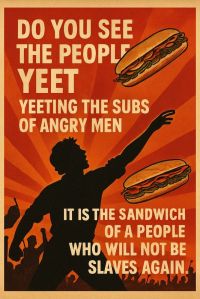
You need to know about revolutionary posters and their style: This image is a satirical take on political propaganda posters, using the imagery of revolutionary struggle but replacing the typical object of desire with a sandwich.
You need to know about a famous political musical: The text “IT IS THE SANDWICH OF A PEOPLE WHO WILL NOT BE SLAVES AGAIN” echoes the iconic song of Jean Valjean in Les Misérables “Do you hear the people sing?” The overall design of the poster, including the silhouette of a person and the rising sun-like rays, mimics the revolutionary aesthetic often associated with Les Misérables.
You need to know about sandwiches: The phrase “DO YOU SEE THE PEOPLE YEET YEETING THE SUBS OF ANGRY MEN” refers to sandwiches sold at ‘Subway’ which are called ‘subs’, short for submarine-styles sandwiches, as they are quite long (I have only eaten these once, so my knowledge is minimal). You get additional points, so to speak, if you know that some of their sandwiches are called ‘hero sandwiches’.
So far, so good. I got all that. But I failed at ‘Yeet’. What does that mean? I am not really immersed in internet meme culture and GenZ slang. After some searching, I found out that this is apparently an exclamation used when throwing something, often with force, or to express excitement, approval, or surprise according to the Cambridge Dictionary and Merriam-Webster.
So, to understand the whole message that this visual metaphor/poster tries to convey, namely that the sandwich throwing man is a hero of the resistance, you need quite a bit of background knowledge! *
Managing reality with metaphors
Metaphors can create knowledge or at least the illusion of knowledge in an instant using any conceptual, cognitive, verbal or visual material to hand. This is great for creative and instantaneous satire. All this improvisation happens in a context of joint sense-making when the knowledge of the speaker and hearer are at least partially aligned. Although this is a highly complex cognitive and communicative task, once these conditions are met, any speaker/hearer with the right sort of knowledge ‘gets it’ in an instant.
It is lovely to think that millions of people all do this spontaneous pattern-matching work together, creating this vast, uncoordinated but somehow coherent collective interpretation of what is happening around us and translating an overwhelming reality into manageable analogies. Perhaps we engage in metaphorical thinking as part of collective symbolic coping when direct political discourse becomes too threatening.
Footnote:
*The Waymo incident and emergent metaphor were quite localised and ephemeral, while the sandwich incident triggered more debate and more creativity, as in these Banksy-inspired posters or this satirical article in The Atlantic.
PS. There is now hilarious courtroom drama around the sandwich incident, read here.
Image: Wassily Kandinsky, Black and Violet, 1923
Acknowledgement: I used Google lens to explain some parts of the poster I discussed above.

 Making Science Public
Leave a comment