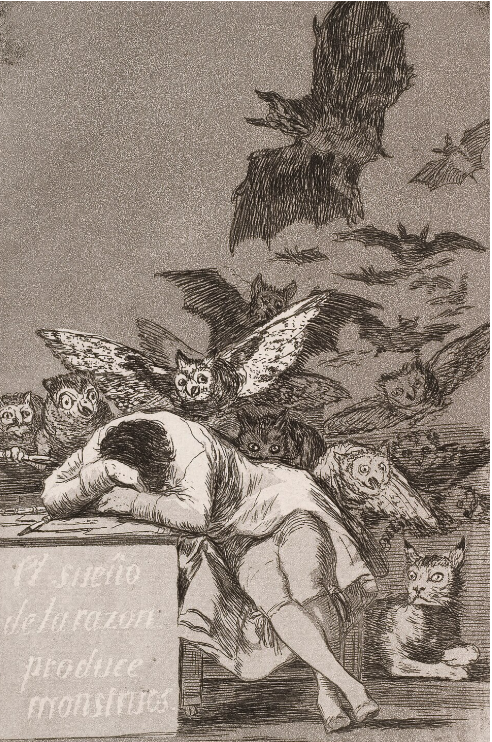
You remember, on 11 October 2026 commercial freezers defrosted all over France after a hacking attack, followed by more such events all over Europe. On 12 October people at Anthropic (who developed AI systems like Claude) published a post entitled “AI models may be capable of self-replicating without access to a datacenter”. Basically, the models would exploit the ‘Internet of Things’ instead. Here is an extract from their post:
“Our experiments suggest that small AI models may be months away from being capable enough to self-replicate on commercial internet-of-things (IoT) devices, like smart ovens and off-brand Android TV boxes. A replicator like this would be challenging to shut down, since there’s no centralized point to shut off—though it may be slow (with a doubling time of days).” And, importantly: “The capabilities that make AI models generally powerful coding agents also generalize to cyber tasks, including autonomous replication. Like coding agents in 2024, we’re seeing signs of life for AI worms. We don’t yet have a full rogue replicator, but agents are becoming increasingly capable of completing the individual steps in the replication chain (and passing on their adaptations to future copies of themselves).” (Italics added)
AI agents had nothing to do with the freezers, but it’s not a big jump from ovens and TVs to freezers and frenetic speculation. The Financial Times reported that: “The developer of chatbot Claude warned that rogue ‘AI worms’ will soon be able to hijack smart devices such as ovens and TVs”. The Guardian wrote: “Anthropic is warning that some of its artificial intelligence models could soon become ‘self-replicating’ and find ways to infiltrate internet-connected devices, such as smart fridges and automatic vacuum cleaners.” And, to top it all, Reuters reported: “Anthropic raised the possibility that rogue AI could spin up a botnet, spread quickly, fight takedown attempts and even break into data centers to turbocharge its growth.”
Worms, botnets, self-replication, autonomous replication, hijack, infiltrate, adaptation, growth, feeding on household devices, and, of course going rogue – what does that all mean? I looked at my very old fridge, toaster and washing machine and was glad that there was nothing smart in our house apart from a ‘smart’ meter and that these old things could not ‘go rogue’. But there was a book on my shelf in which self-replicating machines had gone rogue and I immediately conjured up a dark vision of self-replicating swarms of nanobots emerging from freezers (wrongly, as it turns out). The book was Michael Crichton’s 2002 techno-thriller Prey. On Bluesky Carsten Timmermann reminded me of another classic sci-fi novel which also deals with self-replication, namely Stanislaw Lem’s 1964 The Invincible. And there are many more.
Announcements like the above don’t drop onto society as an empty vessel. They are read in sometimes quite deep socio-cultural contexts that shape their reception. Let’s explore some of these contexts here and see how they can lead to better or worse understanding of what is and isn’t going on in AI and in freezers.
Self-replication in science
Self-replication or “the process by which something, esp. genetic material, produces a copy of itself” (Oxford English Dictionary) has been discussed for a long time. This is in fact a huge topic and if you want to know more about it you should read Rise of the self-replicators: Early visions of machines, AI and robots by Tim Taylor and Alan Dorin (2020).
In biology, the topic covers everything from Darwin through to DNA and RNA to self-replicating viruses to speculations about ‘artificial life’ to synthetic biology and self-replicating xenobots or biobots. In computing, self-replication appeared in research from automata to complexity science. Here I can only point to some milestones.
In 1948–1949, John von Neumann delivered seminal lectures at the University of Illinois and the Hixon Symposium (“The General and Logical Theory of Automata”), proposing the first abstract models of self-reproducing automata. The idea of self-replicating machines was born.
In 1953, the molecular biologist, biophysicist, and neuroscientist Francis Crick and the molecular biologist, geneticist, and zoologist James Watson, drawing on X-ray diffraction studies by Rosalind Franklin and Maurice Wilkins, worked out the structure of DNA, which really does self-replicate.
Six years later, in 1959, the physicist Richard Feynman gave a foundational lecture “There is plenty of room at the bottom” in which he speculated about miniaturised microbiological machines, even mini-factories, that could assemble matter atom by atom and also copy themselves; some say (perhaps wrongly) that this inspired the field of nanotechnology. In August 2024, Carl Feynman, Richard Feynman’s son, published an essay on LessWrong entitled “It’s time for a self-reproducing machine”. He argued that advances in AI and machine tools finally make a real-world self-replicating factory feasible.
In the 1960s, scientists like Francis Crick, Leslie Orgel, and Carl Woese proposed the RNA world hypothesis, sparking decades of discussion on how self-replicating molecules first triggered biological life.
In the 1970s, “Richard Dawkins introduced the notion of replicators—things that self-replicate—as a universalization of evolutionary understandings of genes.” He made this notion popular in his 1976 book The Selfish Gene.
Around 1986–87, the computer scientist Christopher Langton coined ‘artificial life’ and organised the first conference on the topic; in 1986 the engineer K. Eric Drexler popularised the concept of molecular manufacturing in his book Engines of Creation, warning of a sci-fi scenario where uncontrolled, self-replicating nanobots consume all organic matter on Earth – the grey goo scenario which sparked quite a bit of societal discussion around 2003.
Around 1986, computer programmer Craig Reynolds developed ‘Boids’, a computer simulation (artificial life algorithm) of flocking animals that showed how complex, coherent group behaviour could emerge from a few simple, local rules without a central leader. Around 1989, Gerardo Beni and Jing Wang introduced the term ‘swarm’ in the context of research into cellular or swarm intelligence. They described autonomous, decentralised robotic systems cooperating without central control. The concept of self-replication is joined by that of self-organisation.
In 1988, a grad student called Morris launched what came to be known as the Morris worm, one of the world’s first self-replicating computer ‘worms’. Such a worm is computer malware that spreads on a network by replicating itself from one machine to another. This worm severely disrupted email and network operations, causing millions of dollars in damages and the event led to the formation of the first Computer Emergency Response Team (CERT) and modern cybersecurity practices.
In a 1987 article for the New York Times, the historian of science James Gleick wrote this about the ‘artificial life’ debate at the time: “Computer scientists since John von Neumann […] have known that such artificial environments can create ‘self-replicating automata’, organized structures that reproduce themselves.” He quotes one science writer as saying: “If we have a system that can organize itself or can evolve in some sense, then the hope is that down the road the system, without any thought or care on our part, will become intelligent.”
Now, it seems we have intelligent machines that organise themselves without thought or care on our part.
Self-replication in fiction
Again, I can only touch upon a few milestones here. In 1955, that is to say, four years before Feynman’s “Plenty of room at the bottom”, Philip K. Dick wrote Autofac, a short story about automated factories that gain the capacity to reproduce themselves by shooting out tiny pellets loaded with automated/self-repairing machinery to build new factory units, which some commentators now call nanomachines. Similar to Drexler, he warned that such autonomous, self-replicating “metal seeds” might consume the Earth.
About a decade after Autofac, in 1964, the Polish writer Stanislaw Lem wrote a hard sci-fi novel The Invincible, one of the first novels the ideas of a “form of life that has apparently evolved from autonomous, self-replicating machines“, of swarm intelligence and of ‘necroevolution’ (a term suggested by Lem for the evolution of non-living matter). Evolutionary pressure ultimately favoured microscopic, insect-like micromachines that operate collectively as a swarm or an electromagnetic hive-mind or cloud. In her foreword to the 2020 edition of the novel, the literary critic and theorist N. Katherine Hayles argues that it anticipates contemporary research in artificial life.
In 2002 Michael Crichton, author of Jurassic Park, published Prey, a techno-thriller, inspired by Drexler’s grey goo scenario. The novel explores the dangers of out-of-control nanotechnology, genetic algorithms, and distributed artificial intelligence: An experimental cloud of micro-robots (nanoparticles) escapes from a high-tech corporation. The cloud is self-sustaining and self-reproducing. It is intelligent and learns from experience. “And we are the prey.”
One also finds passages like this which seem even more prescient: “But it was one thing to release a population of virtual agents inside a computer’s memory to solve a problem. It was another thing to set real agents free in the real world.” (Part 4, Chapter 31, p. 362 in standard editions) This echoes (although there is no link between the novels) Lem writing: “The flying swarm is immediately sent into the ‘cloud-brain’ formation and its collective memory reawakens.” (Chapter 5, 1973 English translation) That’s ‘going rogue’ big time!
The Invincible and Prey are generally regarded as foundational stories about emergent swarm intelligence, self-replicating microrobots, and non-biological evolution, topics also explored in other sci-fi novels.
From fiction back to fact
That is the scientific and socio-cultural context in which Anthropic’s announcement appeared. It’s not surprising that I immediately thought of Prey when reading the announcement. But was I right to do so?
I overlooked the ‘worm’ in all the excitement! Whereas alien self-replicating micromachines, nanobots and grey goo are purely hypothetical objects, indeed sci-fi, self-replicating software like the Morris worm is real and has been for decades, since 1988. That was the time that Langton talked about artificial life and Drexler talked about nano machines as ‘engines of creation’. But even these scientific speculations have not quite materialised, whereas worms are still there and there was even a proof-of-concept “AI worm” paper, entitled “Here comes the AI worm” in 2024 and in 2026 another paper was entitled “AI Agents Enable Adaptive Computer Worms”. With AI, computer worms are changing and becoming more powerful.
To understand the Anthropic announcement with which I started, we must take off our sci-fi glasses and think about ‘real’ worms (as real in computing as viruses). Interestingly, when reading headlines and articles about the announcement, we must put our sci-fi glasses on again, as we are told that AI is ‘going rogue’. Let’s see what happens when we pass from one domain to the other, from scientific speculation to dramatic speculation.
How to do things with worms
Looking more closely at the whole of Anthropic’s post, one can find a vocabulary that is quite biological: worm, ‘going viral’, ‘patient zero’, R₀, ‘signs of life’, parent copies passing notes on to their ‘daughter replicators’, and a ‘digital slime mold’ living on insecure devices. It even imagines a ‘swarm’ of different models as the realistic worst case. But, and this is important, it is also full of hedges and caveats. The small models ‘may be months away’ from being capable enough; the results come from ‘simplified evaluations’ in which the hacking step is deliberately trivial, which the authors say makes them ‘an upper bound’; and the conclusion says quite clearly: “We don’t yet have a full rogue replicator”. As far as I can see, that is the only time the word ‘rogue’ appears in the body of the post, and it is used to say that we are not there yet.
But by the time the story reached the headlines, the hedges and caveats had thinned out – a pattern very common in science stories. The Financial Times says “rogue ‘AI worms’ will soon be able to hijack smart devices”, where the Anthropic post says ‘may be months away’ on the strength of a lab test. Reuters has rogue AI that could “fight takedown attempts and even break into data centers”. The post does say that AI botnets “could also act intelligently to counter defenders”, but it adds “we haven’t tested this”, and replicators that breach datacentres appear in it as one of several threat models, not as something the researchers have demonstrated. In the post ‘rogue’ is still hypothetical; in the headlines it has become an adjective for the technology itself.
None of this makes the discussed AI capability trivial, but much of it is not new – and we are back to worms, such as the 1988 Morris worm, the 2016 Mirai worm/botnet, which already exploits the IoT and the 2024 proof-of-concept worm I mentioned above. That worm was called Morris II, after the 1988 original, so the lineage is explicit – although it spread by a self-replicating prompt in email assistants, in a lab, rather than by a model copying itself onto hardware.
What about swarms? As roboticists use the word (Robin Murphy makes the point in her review of Prey), a swarm is a large number of simple, identical units with no central control and only weak coordination, like ants. That is a fair description of a botnet, and of Anthropic’s slime mold, but not of Crichton’s cloud, which hunts and learns like a predator.
The words ‘swarm’, ‘worm’ and ‘rogue’ do different things in different contexts. In the context of the Anthropic announcement, ‘swarm’ and ‘worm’, even ‘rogue’ (or rather ‘not rogue’) do relatively honest descriptive work. By contrast, in a broader media context, ‘rogue’ does dramatic narrative work: it turns an AI capability into an AI character with (menacing) intentions. And intentions, as the toaster posters on Bluesky were quick to point out, are exactly what a toaster – and perhaps a worm – lack. (For more on how the toaster has been drafted into this debate, see my previous post.)
So, was I right to think of Prey when thinking about freezers and self-replication and all that? I was wrong to think of self-replicating nanobots. Instead, I should have been thinking of self-replicating Morris worms as well as the unglamorous business of default passwords and out-of-date software and firmware on things like wifi routers and fridge controllers. The French freezers, after all, were reportedly defrosted through a vulnerability in outdated software rather than AI. This might be changing though as AI is increasingly used to find and exploit vulnerabilities and carry out cyberattacks.
But I was also right to think about sci-fi: imaginary stories of things going rogue travel faster than scientific hedges and caveats. Before a replicator has copied itself onto a single smart oven, TV or freezer in the wild, ‘rogue’, as a lexical replicator (a word that copies itself from headline to headline), has already moved in, and it may prove harder to switch off than a freezer. ‘Rogue’ opens a crack in the AI tech narrative through which sci-fi scenarios can creep in.
Image: Wikimedia Commons: Francisco José de Goya y Lucientes – The sleep of reason produces monsters (No. 43), from Los Caprichos (1799)
Further reading
From rogues to collectives: Myths and metaphors after the Hugging Face incident
Rogue AI and the resistance toaster
Acknowledgement: I used Claude to check facts, explain technical points to me and help with the last section. All core ideas and all remaining mistakes are mine.


Leave a Reply