We recently visited Derby and, for the first time in forty years, I actually went into the Cathedral. It doesn’t look very prepossessing from the outside, but boy the inside is great. It is full of light. It was built in 1725 and reflects and interacts with the ideas and values of the Enlightenment era. I loved it.

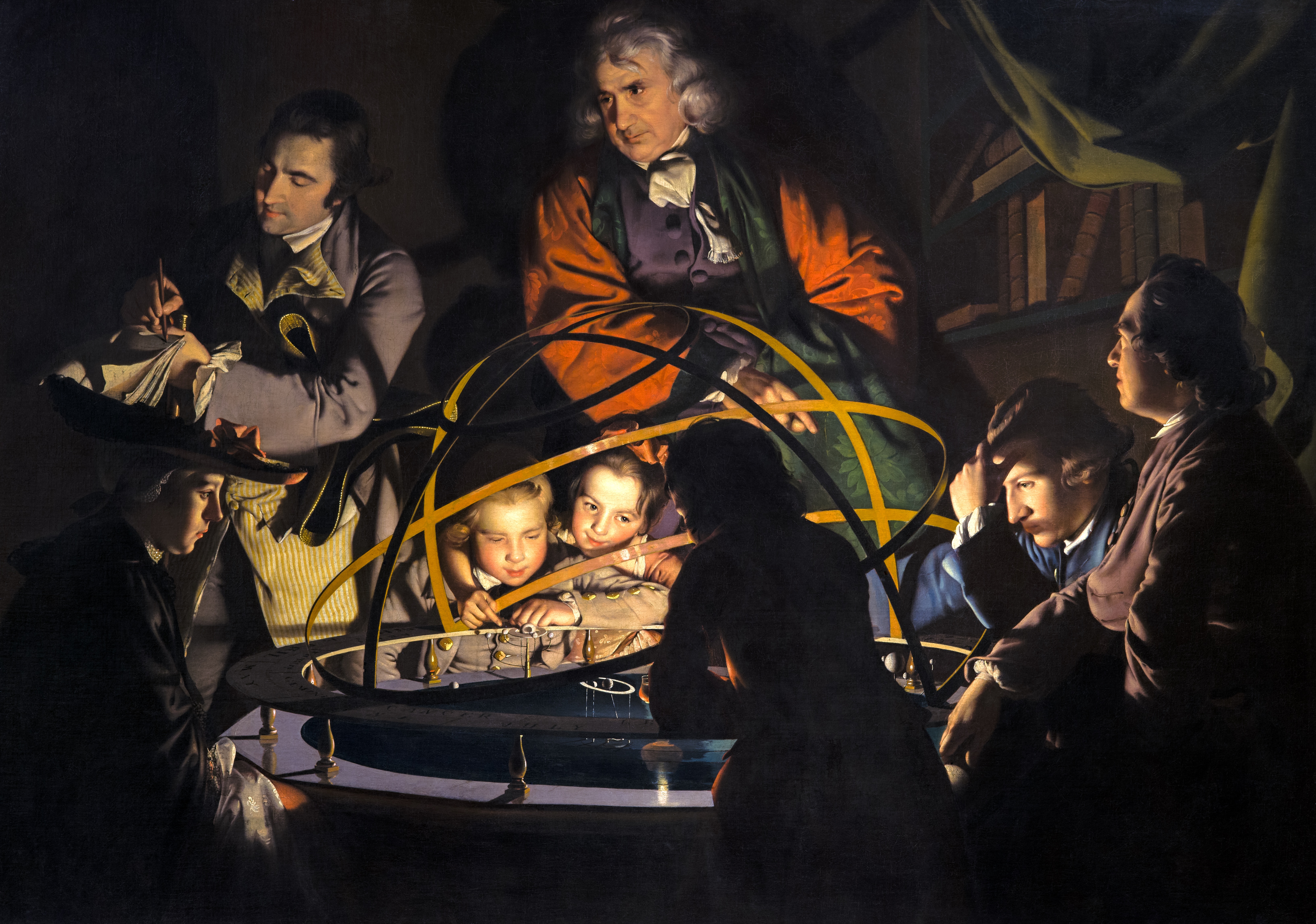
We then went to the Derby Museum & Art Gallery and I saw for the first time Joseph Wright’s (1766) painting The Orrery (a mechanical model of the solar system) Again, what struck me was the light, and of course the fact that, unlike in the anatomy lesson by Rembrandt, it’s not just old white men that do the sciencing, but children are involved too. Wright depicts natural philosophy as a distinctly domestic enterprise, in a scene in which the rapt faces of a whole family are lighted in the glow of the natural philosopher’s orrery lamp (as my friend Kate Roach would say).
Seeing these examples of ‘enlightenment’ made me rather sad though, as we are living in a time of endarkenment. But this also made me remember an essay I wrote forty years ago in 1985 in French about Jules Verne and light. I dusted it off the shelf, translated it into English (with a little bit of help from Claude), corrected some parts, rewrote others and gave it a new title.
In the essay I explore how light functions as a metaphor and aesthetic device in Verne’s Voyages Extraordinaires or Extraordinary Voyages, examining both the textual descriptions and the original illustrations. I discuss how light serves as a mediator between art and technology and between myth and modernity in Verne’s vision of an idealised technological future.
I don’t know whether Verne ever saw the paintings by Joseph Wright, but I bet he imagined the children reading his books by candle light, gas light or electric light looking just as enraptured as Wright depicted them looking at the orrery.

The essay:
The Light Fantastic: Illuminating Myth and Modernity in the work of Jules Verne
Abstract
This essay examines the role of light as a central metaphor and aesthetic device in Jules Verne’s Voyages Extraordinaires, analysing both textual descriptions and original illustrations from the Hetzel editions (1863-1919). Through close reading of key works including Twenty Thousand Leagues Under the Sea, The Adventures of Captain Hatteras, The Black Indies, and The Green Ray, the study reveals how Verne employs natural and artificial light—particularly electricity—as a mediating force between myth and modernity, romanticism and realism. Light functions as one of Verne’s primary tools used to mythologise modern technology, while making mythical spaces habitable through scientific progress. The analysis demonstrates how light enables Verne’s dual pedagogical mission of delectare et prodesse (to delight and instruct), creating spectacles that render the invisible visible and the unknown knowable. Drawing on Hans Blumenberg’s philosophical work on light metaphors, the essay argues that light’s mythologising power gradually diminishes in later works as Verne’s vision becomes more pessimistic, paralleling Max Weber’s concept of modern disenchantment. The study concludes that Verne’s luminous aesthetic represents an ultimately unrealised dream of harmonious coexistence between romantic and technological illumination in the modern world.
Introduction
In 1982 I wrote a dissertation on the illustrations in Verne’s work as part of my teaching diploma. I focused on the change of topic and style in these illustrations over a century (1). I examined 1427 illustrations (full-page, that is, not vignettes), used in 25 EV published between 1863 and 1919 in the volumes of the Hetzel edition. I catalogued, sorted and examined illustrations that represent, for example, extreme situations, theatrical effects, expressions of feelings, landscapes, architectures, gender, occupations etc.
I found (and this figure seems a bit meagre to me today) 75 representations of light effects. These representations fall into two big categories, namely ‘natural light’ and ‘artificial light’ which subsume natural phenomena like rays (of the sun or other), lightning, sun, moon, stars, meteors, volcanoes, aurora borealis, etc. on one hand; fire (from the hearth), candle, gas lamp, electricity, etc. on the other.
The original illustrations accompany the text in such a natural way that today it is almost impossible to imagine one without the other. One notices there, as in Verne’s writing overall, a mixture of myth and reality, romanticism and realism, materialism and spiritualism. Light most often succeeds in reconciling these antinomies.
In the following I’ll first dive into some literary and philosophical aspects of light before discussing four small case studies of how light is used in some of the illustrations included in the Voyages Extraordinaires.
Light – from enchantment to disenchantment
In Writing and Difference (1967), Jacques Derrida spoke of structuralism as an ‘adventure of the gaze’. I would say that the Voyages Extraordinaires, the Extraordinary Voyages (EV), are an adventure of the gaze in the sense that they want to make visible the known world, unknown worlds, as well as imaginary worlds; they want to expose before the reader’s eyes the structure of our natural world and even make them see ‘artificial paradises’. Jules Verne tries to lift the veil of mystery behind which nature hides, but without destroying it, and at the same time, he gives us the spectacle of utopian, dreamed cultures that could be built in harmony with nature.
In this context, light plays an important role. Natural or artificial, it is the principal source of visibility and knowledge; it makes the world visible and comprehensible. The glow of light, reflections of light, the shimmering and the sparkle of light also render the world magical. With the topic of light are associated the themes of gaze, spectacle, amusing fairy tale, surprising revelation, useful instruction, scientific spectacle, as well as magical enchantment, awe and the technological sublime—themes abundantly illustrated (in both senses of the term) in the EV.
As this enumeration reveals, the primary meaning of Verne’s work is: delectare et prodesse, to amuse and instruct, or, as his editor Pierre-Jules Hetzel formulates it: the EV are books of education and recreation.
Jules Verne’s writing succeeds through skilful dialectics in reconciling these two goals, and in this process light in all its variants plays the role of mediator. It has the effect of ‘mythologising’ modernity, the technical world and the real and imagined machines that travel through it. It is in fact one of the ‘mythologemes’ with which Verne weaves the coherence of his work.
The others—with which light often interacts—are darkness, its antonym, and also water, fire, earth, and air. Conversely, the quintessentially modern light, electricity, makes it possible to illuminate, and even to inhabit, mythical spaces: the North Pole, the ocean depths, underground caves and caverns. This at least in the earlier EV.
This mythologising force of light gradually weakens in the EV, as they become more pessimistic over time. This is reflected in the illustrations: in becoming ‘modernised’ (from 1899 onwards, The Will of an Eccentric), they become flat. They are no longer engravings, but drawings that imitate postcards. The illustrations of the first phase, notably those by Bennett, are sharp and luminous; those of the last phase, notably those by Roux, are blurred. Lighting by the sun and stars has lost its fascination: people have become accustomed to electricity. In The Hunt for the Meteor (1908) one no longer admires this natural phenomenon; one simply wants to exploit, liquidate into money this source of light that is made of gold.
I would like to concentrate here on the voyages of the first phase by describing the aestheticisation of technology, this successful reconciliation of art, science, technology and nature, where light functions as mediator. Light confers a totality to the (Vernian) world, gives an overall view of it, makes it orderly and surveyable. However, this light gradually becomes darker in parallel with the process of ‘disenchantment’ (Entzauberung, Max Weber) that characterises the emergence of the modern world. Today’s rationalised, crumbled, fragmented world has lost this totality. It is the charm of Verne’s work that it was still able to represent it.
Light as metaphor
In a philosophical essay on the metaphor of light, Hans Blumenberg enumerates functions of light for which one can find respective illustrations in Verne’s work: “Light can be the directed ray, the guiding beacon in the dark, the advancing disempowerment of darkness, but also the blinding superabundance, as well as the indefinably omnipresent brightness in which everything appears without appearing, the inaccessible accessibility of things. Light creates space, distance, orientability, fearless gazing, it is a gift that demands nothing, enlightenment that can conquer without violence” (2).
A spectacular illustration of this thesis can be found in Twenty Thousand Leagues Under the Sea (20L), which I will discuss shortly. I would first like to say a few more words about Jules Verne’s worldview, by whom was influenced and how it manifested itself in the illustrations for his novels.
Light and the future
Verne’s dream is the discovery of worlds without violence and the construction of ideal cities where nature and technology are in harmony, where one can lead a pleasant and hygienic life (see The Begum’s Fortune, 1879). In short, he wants to save humanity in the double sense of the word. To this end, the light of science must be made useful, and this light shines increasingly brightly in the 19th century so that one can conceive these dreams: the candle is replaced by gas, gas by electricity. Even in the opera gas was employed from 1849 onwards—and are the EV anything other than scientific fairy tales?
In Verne’s work, light can save lives (Five Weeks in a Balloon); it can illuminate the most inaccessible regions of the globe; and it can spread intimate clarity and warmth. It serves the community as well as the solitary individual, including the reader of real or imaginary but instructive books, but also mysterious runes carved into rock (Journey to the Centre of the Earth, 1867). Light is needed to ‘decipher’ the world.
Jules Verne himself, an avid reader, must have discovered in this situation, that is, through reading popular science books and magazines in the light of his reading lamp, the myth of the ‘aurora borealis’ (see the illustrations in The Sphinx of Ice, 1897, and Hector Servadac, 1877), a light phenomenon that, according to the philosopher social reformer Charles Fourier, heralds the day when paradise will have been created on earth (3).

Figure 1: Illustration in The Sphinx of Ice by George Roux
Jules Verne must also have read the richly illustrated books by Frédéric Zurcher and Elie Margollé: The Glaciers (1867); of Camille Flammarion: Imaginary Worlds and Real Worlds (1866) (which he cites in Hector Servadac); and finally of Victor Hugo (whose works are found in the Nautilus library), who had sung in Les Misérables (1862) this song of progress: “Citizens, do you picture the future to yourselves? The streets of cities inundated with light, green branches on the thresholds […] no more hatreds […] peace overall, no more bloodshed, no more wars”. (4) (The musical which made this song, sung by Jean Valjean, famous was first performed in France in 1980 and then in England in 1985, just when I was writing the French version of this essay). Sadly, this future has not arrived yet.
Illustrations, light and spectacle
Victor Hugo, himself an illustrator of his texts and visions, had accorded increased importance to image and theatrical decor. He already glimpsed the effect that the superposition of these two semiotic codes—language and image—can produce. Jean Adhémar, in a book on illustrations, writes about Hugo’s Preface to Cromwell (1827) that in Victor Hugo “the writer and illustrator are intimately linked and on equal footing. One recognises in the image a signifying virtue hitherto the privilege of writing.” (5)
This new appreciation of illustration corresponds to the desire of romantic writers to be ‘popular’, which brought about a “democratisation of abundantly illustrated publishing” (6). Hetzel knew how to exploit this tendency; Verne profited from it.
Four case studies of light between myth and modernity
Being unable to analyse in detail all the light effects described by Jules Verne in the space of this essay, I limit myself to the following three occurrences of this theme, with a focus on the first:
- Light in Twenty Thousand Leagues Under the Sea (20L) (1869-70), where electric light plays a huge role (as it does indeed in many other novels, such as Robur the Conqueror, 1886, for example);
- Light in The Adventures of Captain Hatteras (CH) (1866), where it appears in all its mythological and glacial splendour, although here too electricity plays a role;
- Light and the cavern in The Black Indies (IN) (1877-1878), where one can observe a reversal of the Platonic myth of the cave;
- Light and the grotto, but in a context of gaiety and love in The Green Ray (GR) (1882).
Twenty thousand leagues under the sea, light and science
20L is Jules Verne’s most Baudelairian work—and let’s not forget that Charles Baudelaire was the poet of modernity! Captain Nemo closely resembles “The Man of the Sea” and the underwater landscape through which the Nautilus glides resembles that described in “Former Life”, two of the poems in Baudelaire’s The Flowers of Evil (1857):
Long have I lived beneath vast porticoes
That ocean suns tinged with a thousand fires,
And whose great pillars, straight and majestic,
Made them seem, at evening, like basaltic grottoes.
The swells, rolling the images of the skies,
Mixed in a solemn and mystical way
The all-powerful harmonies of their rich music
With the colours of sunset reflected in my eyes.
There I lived in calm voluptuousness,
In the midst of azure, waves, and splendours…
In 20L the ‘ocean suns’ are replaced by the normal sun, but which, penetrating this liquid mass of the sea, produces magical effects. It changes water into air and operates a liquidation of light, a transformation of sand into gold—the elements are transformed into one another in an almost alchemical way.
The underwater landscapes of Crespo Island where Captain Nemo walks with his guests are lit by the sun which, however, when night comes, is easily replaceable by the beacon of the Nautilus (or by ‘Ruhmkorff’ apparatus) whose light produces “magical effects”.
The Nautilus’s light beacon is a constant iconographic element in the history of Vernian illustrations. The Nautilus itself, gently lit inside by electric lamps, is a sort of comfortable and… mobile theatre box. Without running serious dangers, one can look through a large porthole at the external world illuminated by electric rays. From time-to-time spectators can even penetrate onto the ‘stage’ after donning ‘diving suits.’
It is a perfect staging of science because, as M. Buisine writes, “what presents itself as description of the visible is then only representation in the theatrical sense, a staging of scientific discourse”. (7) The porthole or diving suit mask are the frame and filter through which Verne’s heroes see the sea and its inhabitants, from small fish to a large kraken. Their contact with this underwater world is not direct and concrete but indirect and abstract. They do not look at nature directly, but through certain prostheses. The novel’s heroes look at it in the form of theatrical ‘tableaux’ which are themselves represented to readers in the form of illustrated text.
One can recognise here a growing alienation between humans and nature in a bourgeois world where one nevertheless has an insatiable desire to see. In 20L the sea becomes a living image, but well-framed, a sort of aquarium. The mythical space becomes one more decorative element in the Nautilus’s comfortable interior. I quote Buisine once more: “The edge of the tableau, the limit of the drawing do not cut the represented reality. The circularity of the porthole is the modernist form of the rectangular frame. Verne’s representation, like all classical description, ‘transforms reality into a painted object.’” (8)
How Verne’s heroes react to these light-filled visions is interesting. It curiously resembles that of the imagined readers of these tales (and remember the children in Joseph Wright’s painting!): “Amazed, we were leaning on our elbows before these showcases, and none of us had yet broken this silence of stupefaction, when Conseil said, ‘You wanted to see, friend Ned, well, you see!’ ‘Curious! Curious!’ said the Canadian, who, forgetting his anger and escape plans, underwent an irresistible attraction… and one would come from farther away to admire this spectacle!” (p. 146) Ned Land expresses here a certain scepticism toward this technically perfect illusion machine that is the Nautilus, but he too succumbs to the fascination it exercises.

Figure 2: Illustration by Alphonse de Neuville
What the Nautilus is in underwater space, the space capsule is in From the Earth to the Moon (1865) and Around the Moon (1869). Here the porthole also allows to look safely at, for example, a lunar, indeed extraterrestrial, spectacle of fire and light.
Let’s return to 20L and the Nautilus. Its light can illuminate underwater regions that natural light had never reached. We even have a ‘photo’ of it, reproduced by an illustration! “it is the positive proof that I give here (it’s Aronnax speaking). One sees these primordial rocks that have never known the light of the heavens.”
The adventures of Captain Hatteras, light and mythology
Beside sky and sea, the North Pole constitutes another mythical space famous in Jules Verne’s time. We have already spoken of the popularisation books on this subject from which Verne may have drawn certain ideas. The spectacles, the incredible fairy tales of the aurora borealis, of shimmering icebergs and ice-covered seas that became so popular during the times of polar exploration are described and illustrated in detail in CH.
Verne writes about the Northern Lights: “One cannot understand the enchantment of such a spectacle (la féerie d’un tel spectacle), in high latitudes, less than eight degrees from the pole; the aurora borealis glimpsed in temperate regions gives no idea of it, even in a weakened form; it seems that Providence has reserved its most astonishing wonders for these climates.”
But progress projects its light even into this inaccessible region. The Nautilus beacon is replaced there by a light machine invented by M. Clawbony. One sees it at work in an illustration subtitled “There’s M. Clawbony making sun now!”

Figure 3: Illustration by Édouard Riou
Here, Charles Fourier’s myth of the aurora borealis as central to establishing a utopian system of society enters into competition with the reality of progress accomplished in the 19th century.
The Black Indies, light and utopia
In the caves of New Aberfoyle, a fictional underground mining city in Scotland (IN), the sun is completely replaced by electricity—it is eclipsed—the luminous utopia begins. Verne writes in IN: “The visitor, arriving at Coal City, found himself in a milieu where electricity played a primary role, as agent of heat and light” , and then: “an intense light filled this dark environment, where numerous electric discs replaced the solar disc.” One penetrates one of the famous caverns, a privileged place of Vernian reverie. In his already cited essay, Hans Blumenberg comes to speak of light and the cavern: “The cave is not simply the counter-world of light, just as darkness is the ‘natural’ opposite of brightness. The cave world is an ‘artificial’, indeed violent underworld to the sphere of natural light and natural darkness, a region of shielding and forgetting.”

Figure 4: Illustration by Jules Férat
For Plato the world inside the cave is the normal, human world, the world of shadows that give us the illusion of reality. He opposes to it the world outside the cave, extraordinary region where sages and philosophers alone succeed in seeing the light of truth that dispels the darkness of ignorance and lies of the everyday world. According to Plato, the world inside the cave is artificial, therefore false.
Blumenberg opposes to this Platonic myth the Ciceronian conception of the cave which strangely resembles that of Jules Verne: “The Ciceronian cave world is of ‘urban luxury’, a dazzlingly arranged cultural sphere that you holds captive through its mere attractiveness.”
Hence a radical reinterpretation of the cave myth after Cicero: it becomes the starting point of progress. The exit from the cave in Plato operated a transformation of the isolated individual. In the modern myth of the cave, illustrated by Jules Verne, one must not leave the cave to find light! The cave is the very place where a new world is prepared for everyone. It is no longer a matter of individually acquiring the light of knowledge, but of creating a common living space where light shines for everyone. The sage is replaced by the engineer.
The Green Ray, light and love
To conclude, I would like to cast a brief glance at a little masterpiece radiating gaiety: The Green Ray. One finds there the two motifs of the theatre, encountered in 20L, and of the grotto, encountered in IN, united by romantic light to form a touching tableau: “…there were astonishing plays of light and shadow. Everything was extinguished when some cloud fell before the opening of the grotto, like a gauze curtain on the proscenium of a theatre. Everything shone on the contrary, and brightened with the seven colours of the prism, when a gust of sun, reverberated by the crystal background, rose in long luminous patches to the head of the nave… But the impression they had felt would never fade from the memory of the actors and witnesses of this scene, which had had for theatre this legendary grotto of Fingal.”

Figure 5: Illustration by Léon Benett
But the main subject of GR is an optical curiosity, the green ray, that Miss Campbell had desired to see at any price. And yet, when finally, after multiple adventures, she has the opportunity, she does not look, because her eyes are fixed on those of her lover and their black ray.
An admirer of Miss Campbell, a painter by trade, paints the green ray, although he has never seen it. Standing before this painting, the brothers Sam and Sib, who have seen the green ray although they didn’t want to see it, make the following remark: “And even, replied brother Sam, it’s better to look at the green ray in painting. – Than in nature, replied brother Sib….”
Is the aestheticisation of science and nature by art and light of which I spoke at the beginning of this essay here surpassed by a supernaturalism à la Baudelaire? The latter writes this in his Parisian Dream:
Architect of my fairy tales,
I made, at my will,
Under a tunnel of gems
Pass a tamed ocean;
And everything, even the black color,
Seemed burnished, clear, iridescent;
The liquid enshrined its glory
In the crystallised ray.
No star elsewhere, no vestiges
Of sun, even at the bottom of the sky,
To illuminate these prodigies,
Which shone with a personal fire!Conclusion
Conclusion
Guided by the light of progress and poetic inspiration, Jules Verne, this other poet of modernity, has left us an entire architecture of extraordinary fairy tales, fodder for our personal dreams. He wanted to create a modern world where the sun, moon, and stars—romantic light—and electric lamps—utopian light—could coexist, where these different variants of light shine in harmony for the greatest happiness of humanity. Light in all its forms slips into nature by embellishing it, thus avoiding any technocratic dictatorship. This vision of a modern world has unfortunately remained a dream.
Image: Joseph Wright, 1766: A Philosopher Lecturing on the Orrery, or, A Philosopher giving that Lecture on the Orrery in which a lamp is put in place of the Sun (Wikimedia Commons)
NOTES
(1) B. Nerlich. Bedeutung der Illustrationen für die Jules-Verne-Rezeption. Schriftliche Hausarbeit im Rahmen der 1. Staatsprüfung für das Lehramt für die Sekundarstufe II. Düsseldorf 1982. (2) H. Blumenberg: “Licht als Metapher der Wahrheit”. Studium Generale 10 (1957), 432-447. (3) Cf. Ch. Robin. Un Monde Connu et Inconnu. Jules Verne. Nantes 1978, p. 159. (4) V. Hugo. Les Misérables. Paris (Éd de la Pléiade) 1971, p. 1213. (5) J. Adhémar (éd.). La gravure. Paris (PUF) 1980, p. 92. (6) Ibid. (7) A. Buisine. “Un cas limité de la description: l’énumération. L’exemple de Vingt Mille Lieues sous les mers.” In La Description. Lille (Éd. Universitaires) 1974, p. 91. (8) Ibid.
Citations from the Voyages Extraordinaires are from the Rencontre edition. I obtained the illustrations for this essay from Wikepedia and The Illustrated Jules Verne: http://jv.gilead.org.il/rpaul/
EPILOGUE
After 1982 I did not pursue my dream of writing a book on Jules Verne’s illustrations, but I wrote small essays that built on this passion of my youth.
Nerlich, B. (1987). “Voyage à travers l’Impossible”, pièce fantastique. Essai d’interprétation fantastique. Revue des Lettres modernes. Jules Verne 5: Émergences du fantastique. Minard. – I would have to retype that as well…. At some point….
Nerlich, B. (2005). From Nautilus to nanobo(a)ts: The visual construction of nanoscience: Azojomo.
And I wrote several blog posts that mention Jules Verne, this one in particular on Making Science Visual.
Acknowledgment
I used Claude (Anthropic) to help me translate this essay from French into English.
Leave a Reply