Sitting on a bus and browsing my timeline on Bluesky on Friday 9 January, I came across a comment by Gaia Vince saying: “Interesting to see the Guardian running a couple sensible opinion pieces on geoengineering recently”.
I opened an article she pointed to and immediately saw a juicy metaphor: “In this sense, research acts as a guardrail – not a slippery slope.” Ah, I thought, perhaps I can find more metaphors and update my work on collecting geoengineering metaphors which I stopped in mid-2025.
I went home, it was slippery, I banged my head on a ‘guardrail’. Nothing too bad. Later in the day, when I told my husband about the geoengineering article I had read, he said “Ah, I see a blog post coming on. What about ‘Don’t bang your head on the guardrails!’ as a title” And here we are….
I went back to my desk and found not only one but four articles on geoengineering published in The Guardian at the beginning of January 2026. I downloaded them, read them and extracted some more metaphors. I then compared them to earlier metaphors used between 2009 and 2025. I found both continuity in metaphor use and some interesting new developments. But first a brief definition of geoengineering.
Geoengineering
The Met Office defines geoengineering as follows: “Geoengineering describes interventions and technologies which could be deployed to alter aspects of the global climate system to help tackle some aspects of global warming. These methods are increasingly debated as people around the world consider how best to minimise the risks of climate change. There are two key categories that fall under the term ‘geoengineering’: Greenhouse Gas Removal (GGR) is the use of natural and artificial means to take greenhouse gases from the atmosphere and sequester them for an extended period of time. This could include planting trees or encouraging marine phytoplankton growth, through to technology which can chemically remove CO2 from the atmosphere or employing a process known as bioenergy carbon capture and storage (BECCS) (where biomass is burnt for energy and the carbon dioxide captured). Solar Radiation Modification (SRM) is use of technologies to reflect some of the Sun’s energy that reaches Earth back into space, thereby reducing the Earth’s temperature to offset global warming. This could include strategies to brighten clouds over the ocean or injecting aerosols high into the atmosphere.”
The articles in The Guardian mostly focus on SRM.
Geoengineering metaphors in UK newspapers: 2009 to 2025
I have been interested in geoengineering metaphors since around 2009* when the Royal Society published a landmark report. With the help of Rusi Jaspal in the early years and Claude Sonnet 4.5 over the last year, I charted changes in metaphors between 2009 and 2025. Here is a summary of our findings:
In that time, geoengineering metaphors in UK news discourse evolved through three phases, reflecting shifting attitudes toward climate intervention.
Early coverage (around 2009-2010) used metaphors positioning the planet as a machine to be fixed (adjusting the “thermostat”), a body needing protection (“sunscreen”), or a patient requiring treatment (“chemotherapy”, “methadone” or now “ozempic“), all supporting a master-argument that catastrophic climate change might necessitate geoengineering as a last resort.
By 2013, after the abandoned SPICE project (Stratospheric Particle Injection for Climate Engineering), right-leaning outlets normalised geoengineering through comparisons to everyday activities while left-leaning papers emphasised moral hazard and uncertainty.
A May 2025 funding announcement by the ‘Advanced Research and Invention Agency’ ARIA about initiating research into geoengineering triggered a heated debate: ‘dimming the sun’ became the dominant metaphor across nearly all outlets, evoking ominous tampering rather than protective care, while new gambling metaphors (‘playing poker’) and ‘slippery slope’ warnings emerged alongside persistent concerns about who controls planetary-scale interventions, reflecting both growing public scepticism and an underlying tension between techno-optimistic ‘fixes’ and fears of unintended consequences.
Geoengineering metaphors in The Guardian: January 2026
The Guardian published four articles on the topic at the beginning of this year:
- “We can safely experiment with reflecting sunlight away from Earth. Here’s how”; Dakota Gruener and Daniele Visioni, Tuesday 6 January
- “We study glaciers. ‘Artificial glaciers’ and other tech may halt their total collapse”; Brent Minchew and Colin Meyer, Wednesday 7 January
- “If geoengineering is ever deployed in a climate emergency, transparency is key”; Ines Camilloni, Thursday 8 January
- “Some want to ban vital geoengineering research. This would be a catastrophic mistake”; Craig Segall and Baroness Bryony Worthington, Friday 9 January
The first article urges governments to engage in safe and responsible solar engineering. The proposed approach borrows metaphorically from phased clinical trials in medicine, and a key metaphor is that “research acts as a guardrail – not a slippery slope.”
The second article deals with the dangers of melting glaciers and sea-level rise and proposes various technological interventions. The key metaphor is “We cannot afford to debate until the tide is at our door”.
The third article centres on climate justice, transparency and inclusivity and a key metaphor is: “We must not let geoengineering be shaped behind closed doors”.
The fourth article argues that we have already geoengineered the planet using fossil fuels and now need to explore more deliberate and honest ways to counteract the consequences. This is seen as “the necessary next step in responsible climate action”. This journey metaphor is elaborated as: “To shut down inquiry is to close off the path to knowledge we need to separate the reckless from the responsible.”
Let us now look at the main types of metaphors used and how they compare to those enployed in the past.
Continuity in metaphor use
Medical and safety metaphors
Most of the articles still use some core medical or safety metaphors and a framing of treatment and cure is implied throughout. Examples are “emergency break” (Camilloni) – positioning geoengineering as emergency (safety/medical) intervention and “temporary bandage” (Camilloni) – emphasising limited, temporary nature. A more extended medical metaphor is used by Gruener & Visioni, and I’ll come back to that later.
Several articles use the metaphor of ‘buying time’ and/or ‘breathing room’ which can be compared to palliative care (prominent in Segall & Worthington). The ‘buying time’ metaphor appears central across multiple articles, which positions geoengineering as a temporal intervention rather than a permanent solution.
Planetary body/patient metaphors
Such metaphors are not so much in evidence, but they are implied. The planet is portrayed as something that needs protection or intervention. The fact that the earth is getting hotter is stressed in all the articles, which implies a planetary ‘fever’. There is also talk of the ‘darkening’ of the planet (Segall & Worthington) which is the result of “wrapping the planet in heat-trapping gases”. This then means that “reflective ice is disappearing, clouds are shifting, and particulate pollution is increasing. The planet is, quite literally, darkening.” There is also talk about a ‘heat shield’ being deployed (Gruener & Visioni).
Machine and technology metaphors
There is some evidence of machine and engineering metaphors, highlighting technologies and interventions that can manage ‘feedback loops’ in the climate system. Technological fixes are prominent in the article by Minchew & Meyer on ‘artificial glaciers’ treating ice as an ecosystem to be conserved/managed in order to avoid disasters, especially linked to the melting of the Thwaites ‘doomsday glacier’.
Change in metaphor use
Medical metaphors
Medical metaphors have always been used in talk about geoengineering but the article by Gruener & Visioni is based on a whole new extended medical metaphor, that of the ‘phased clinical trial: phase one, phase two, phase three experiments, explicitly comparing stratospheric aerosol injection or SAI research to medical trials.
The clinical trial metaphor is elaborated in great detail in what seems to be a deliberate strategic framing to normalise the research by comparing it to accepted medical research protocols. This is much more developed than the general medical metaphors we found earlier.
Slippery slope metaphors
The same article also reuses an old metaphor, namely that of ‘slippery slope’, but reverses it so to speak when it argues that small-scale responsible and open research into SAI can act as guardrails rather than being a slippery slope and that “Outdoor research is not a slippery slope to deployment”. The metaphors of guardrails and slope can also be seen as belonging to the family of journey metaphors.
Journey and container metaphors
We did not find many journey or container metaphors in our previous research. This is different now as all the articles want to set out responsible ‘pathways’ to geoengineering.
Journey metaphors are everywhere and are easily overlooked; think about ‘untrodden paths’ or ‘the path to wisdom’ or the ‘path to recovery’. The article by Camilloni contains a journey metaphor that stresses that “Any effort to correct the path of our planet after generations of polluting must be debated in the light” – that is in the light of climate justice.
Segall & Worthington claim that “To shut down inquiry is to close off the path to knowledge we need to separate the reckless from the responsible”. Gruener & Visioni would agree, as they “see the UK’s Advanced Research and Invention Agency (Aria) program as a strong first step in that direction”. This is echoed by Segall & Worthington who say that “Holistic planning …. is the necessary next step in responsible climate action”.
Container metaphors too are ubiquitous; think back to the times of Covid and talk about ‘bubbles’, ‘cocoons’ and ‘protective rings’ and so on, or the virus being ‘at your door’, which of course you had to keep closed. In the context of geoengineering, the door also plays a role, as when Minchew & Meyer talk about the fact that “We cannot afford to debate until the tide is at our door” and that “We cannot ‘move fast and break things’ – but we also cannot afford to debate until the tide is at our door.” This highlights that the effects of global warming, such as sea-level rise, are ‘at our door’ and will soon breach it, unless we think more clearly about geoengineering and follow a reasonable path to avoid disaster.
Transparency/governance metaphors
Camilloni’s article introduces some novel transparency and governance metaphors, based on container and light metaphors. Arguing for climate justice she points out that if geoengineering is “ever considered as part of a planetary emergency response, we must not let it be shaped behind closed doors. Climate justice demands a transparent approach.” This means that geoengineering “must be debated in the light.” Doors and windows must be open here; rather the opposite to the door metaphors in the Minchew & Meyer article, where they must be closed. Similar metaphors; different arguments.
Colonial justice metaphors
The article by Camilloni also stresses that it is important to have “Solutions designed for us but not with us” – and by us she is referring to the Global South.
Conclusion
As we have seen, some metaphors, especially medical ones, stayed the same, but there were also some innovations.
While in the past metaphors expressed worries about the planet overheating, worries about geoengineering leading to a ‘moral hazard’ diverting attention away from climate change mitigation, and worries about unintended consequences, the novel metaphors try to steer a path between sounding the alarm and advocating responsible research. Path or journey metaphors are important here.
The metaphorical tone adopted in the articles is quite different compared to some of the hype and hysteria inherent in older metaphors. Overall, these articles all stress responsibility, care, openness, transparency, accountability and safety without understating the dangers posed by global heating and the need for urgent action. The ominous metaphorical framing of ‘dimming the sun’ is absent, for example.
Amongst all these emerging metaphors the guardrails vs. slippery slope framing is perhaps the most interesting. It seems to be a fascinating rhetorical move by Gruener & Visioni in which they are directly taking on the critics’ metaphor of ‘slippery slope’ and flipping it – essentially saying that research is the guardrail that prevents the reckless deployment of geoengineering. It is a clever defensive manoeuvre that tries to reframe caution as requiring more research rather than less.
There seems to be a shift then between the metaphors used in UK newspapers in May 2025 and the ones used in The Guardian now. The 2025 metaphors emerged around ARIA’s May 2025 announcement that they would be carrying out research into ‘climate cooling’, and now. This triggered some heated debated and the metaphor of ‘dimming the sun’ was a focal point. The 2026 metaphors, used mainly by researchers and advocates, are of a somewhat cooler nature and the ARIA programme is even seen as a necessary ‘first stop’ on ‘path’ to responsible research that has agreed ‘guardrails’.
To come back to Gaia Vince’s quote at the beginning of this post: perhaps we are seeing at last some sensible opinion pieces about geoengineering in the news. Is this a sign of a cooling of the geoengineering discourse more generally, from heated ‘dimming the sun’ alarm to cooler ‘guardrails’ responsibility? To answer that question, we need a larger sample of articles and continued metaphorical vigilance.
Postscript – on how metaphor detection is an endless process
I was just putting the finishing touches to this post, when I saw this comment on Bluesky by Doug McNeal just saying “peak shaving“. Oh I thought what’s that? It refers to an preprint by Ben Sanderson and colleagues entitled “Robust assessment of Solar Radiation Modification risks and uncertainties must include shocks and societal feedbacks”. In that article they refer to “different modes of potential deployment [of SRM], ranging from optimistic ‘peak-shaving’ scenarios to combinations which maximise risk of regional conflict or mitigation slowdown”. It seems that this metaphor has been in use for a while without me noticing it. So there we have it. One should also investigate scientific metaphors in geoengineering not just media ones. That scientific metaphor seems to be linked to the ‘buying time’ one used in general discourse. To a lay person like me the metaphor of “peak shaving” sounds like it came straight from electrical grid management or signal processing. Its meaning is probably something like cutting off temperature spikes which lends it some engineering precision. But it also makes climate intervention sound like trimming (indeed ‘clipping‘) a hedge rather than… deliberately messing with planetary systems through ‘dimming’ and ‘cooling’. There is so much in there!
Footnote on etymology
In its current meaning of “intentional large-scale manipulation of the global environment” (see David Keith, 1998), the term ‘geoengineering’ has been in use since the 1990s. The Guardian reported on it in 1994, mentioning space mirrors (see OED). Geoengineering became more prominent after Paul Crutzen, winner of the 1995 Nobel Prize in Chemistry, published an editorial in the journal Climate Change in 2006 in which he coined the term “Anthropocene” and claimed that an “escape route” was needed if global warming began to run out of control. He proposed a method of artificially cooling the global climate by releasing particles of sulphur in the upper atmosphere which would reflect sunlight and heat back into space (Crutzen, 2006, p. 216). In 2007 Nature published an article by Oliver Morton provocatively title: “Climate Change: is this what it takes to save the world?”. After 2009 and the Royal Society report the term went mainstream.
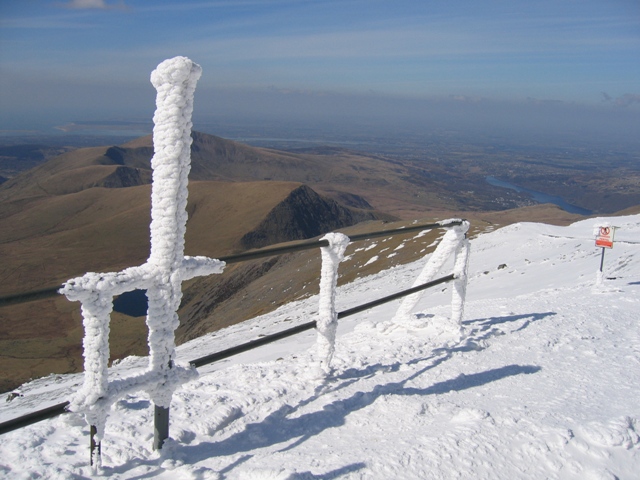
Image: Wyddfa-Snowdon station platform and view – with guardrails and a slippery slope (Wikipedia)


 Making Science Public

Leave a reply to Robert Dingwall Cancel reply