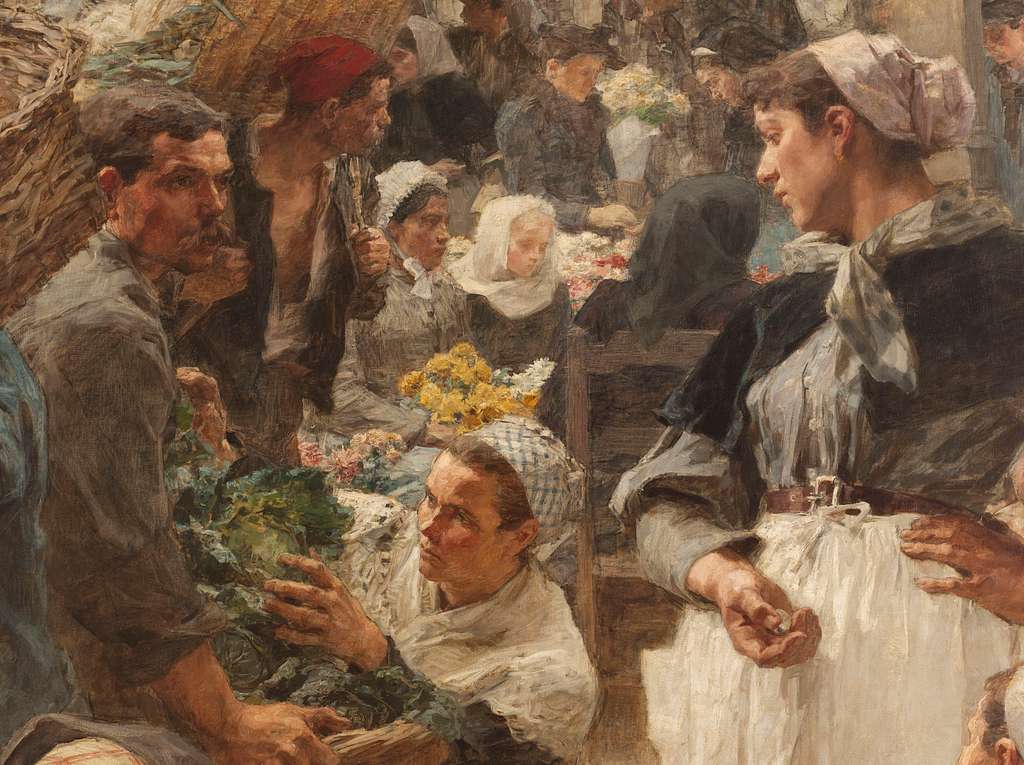
I was talking the other day with some people about AI metaphors. During that discussion the thorny question came up ‘what are metaphors anyway?’, followed by ‘is there anything in language that’s not metaphorical?’. This brought to mind a very old quote. In 1730 the grammarian and philosopher César Chesneau Du Marsais said: “I am convinced that more figures of speech are produced in a single day at the market (Les Halles), than in several days of academic assemblies.” This was not just a throwaway remark. It was part of a revolution in understanding how language and thought work.
In the 1980s we thought we were witnessing a revolution in how metaphor and indeed thought and language worked when cognitive linguists built on seminal work by George Lakoff and others epitomised in the book Metaphors We Live By (1980).
In this post I’ll show that many of the revolutionary claims made in the 1980s about metaphor have an at least 250-year-old history. There was awareness that metaphors and other tropes or figures or speech are not just rhetorical decoration, but that they are the foundation of thought and language; that there is no real literal/figurative divide; that our bodies shape our concepts; and that metaphors are ubiquitous.
To reconstruct some pivotal points in this forgotten intellectual tradition, I’ll use an article written by my old colleague Hans-Walter Schmitz in 1985 on the ‘Durchgängige Tropisierung der Sprache’ – the consistent tropification of language – and an article written by me and David Clarke in 2001 in which we trace some of the historical roots of conceptual metaphor theory. By tropification Schmitz means that language emerges from, and is constantly evolving through, the use of tropes, such as metaphor and metonymy for example.
Before the 17th century metaphor was primarily viewed as a rhetorical, oratory or poetic device, a departure from literal language used for stylistic purposes such as embellishment and vividness of expression. This changed during the 17th century when philosophers discussed the dangers of metaphor, as they feared that it obscured the clarity of scientific thinking and thus perhaps impeded the emerging scientific revolution. The flipside of these reflections was that philosophers also began to realise that metaphors are actually essential for the formation of ideas and concepts, including scientific and philosophical ones.
This cognitive dissonance is perhaps best encapsulated in John Locke’s famous saying that metaphors are ‘perfect cheats’, while also pointing out that “To comprehend and apprehend, are words taken from the operations of things sensible, and applied to certain modes of thinking. […] and I doubt not [that…], the names which stand for things that fall not under our senses, to have had their first rise from sensible ideas.” (1689).
Let us now go a bit further back in time to Clauberg and then skip over Locke to Leibniz, Du Marsais and Lambert and see what these lesser known contributors to linguistic thought have to say about ‘why metaphors are necessary and not just nice’.
Clauberg and the physical basis of abstract thought
Johann Clauberg was a German Cartesian philosopher and theologian who published a book entitled Ars etymologica teutonum in 1663.
In this work on etymology Clauberg discovered a pattern: words for sensory or physical experiences are systematically transferred to describe intellectual concepts. He gives examples such as: ‘grasp,’ ‘comprehend,’ ‘perceive’ which were all originally tactile/physical terms: capio (to grasp) → percipio (perceive) → concipio (conceive) → concept. He therefore formulated the rule: ‘Words for intelligible things are predominantly transferred from sensible things’ and he saw this as reflecting how perception precedes understanding developmentally.
It is not totally clear whether Locke knew about the Ars etymologia but Leibniz did.
Leibniz and the constant flux of meaning
In his 1670 Preface to an Edition of Nizolius [philosophical work by Italian humanist Marius Nizolius], Gottfried Wilhelm Leibniz introduced the concept of the ’channel of tropes’ (per canales troporum) to explain how philosophical language evolves and acquires new abstract meanings from original, concrete usages.
To give just one example: take the word ‘fatum’ meaning fate. How did the word get that meaning? This happened through the consistent tropification of language:
- Started as dictum – ‘something spoken’
- → ‘What the gods spoke’ (antonomasia)
- → ‘Divine pronouncement about the future’ (synecdoche)
- → ‘The future itself’ (metonymy)
- → ‘Fate’ as we know it
This shows how a word travels through multiple semantic shifts, each building on the last, until its original meaning is completely obscured. Nobody invented this chain of semantic change – it evolved through use. Leibniz’s insight was that this happens with EVERY word. Almost all usage originates from tropes. Think about modern phrases like ‘browsing the web’ or ‘storing in the cloud’.
But this created a dilemma for philosophy: how do you think clearly when your tools (words) are all carrying hidden metaphorical baggage? Leibniz’s answer was: You can’t avoid it. Even trying to be literal requires tropification. He advocated using words in their ‘original meaning’ when possible but to recognise that all new concepts require new words or the tropification of old ones, including the use of metaphor. This has impact on semantics synchronically, how we use words in the present, and diachronically, how language and meaning change over time.
Du Marsais and metaphors on market day
The Enlightenment grammarian, philosopher and contributor to Diderot and d’Alembert’s famous Encyclopédie, César Chesneau Du Marsais (or Dumarsais) wrote a treatise in 1730 (revised in 1757) entitled Traité des Tropes. This became the basis for much of the Encyclopédie’s treatment of rhetorical figures.
This treatise was, in a sense, written in the classical rhetorical tradition, defining metaphor primarily as a transfer of meaning from a proper to a figurative sense. In another sense, it was quite revolutionary.
He took tropes, including metaphor, out of rhetoric and put them in semantics, so to speak. In traditional rhetorical textbooks, tropes are defined as special devices used on special occasion by skilled speakers; and they are seen as optional. For Du Marsais, they are instead how meaning works, they are used in everyday life, by everyone; and they are unavoidable. As he stressed, you find more figures on market day than in academic assemblies.
Why is the use of figures of speech so ubiquitous he wondered… He listed various reasons, among them passion, imagination and the association of ideas. Passion creates urgency; imagination enables us to see similarities and connect ideas; and associating ideas in context blurs boundaries and shapes meanings.
Du Marsais posited various functions of tropes. There were the more traditional ones, such as giving force to expression, decorating speech, making speech more dignified, masking unpleasant ideas; but there were also more novel ones such as recalling main ideas through associated ones and enriching language by multiplying uses. This is key to the evolution of language and meaning. Tropes don’t eliminate ambiguity – they create productive ambiguity! These are metaphors and ambiguities we live by.
Du Marsais’ main insights can be encapsulated by these three statements: Every utterance requires interpretation. The literal/figurative distinction is observer-dependent, not inherent to language. Most importantly: tropes are natural, ordinary, and universal in human speech.
These ideas were similar to those of Giambattista Vico, an Italian philosopher who worked around the same time and posited that metaphor was not just a stylish flourish but a fundamental cognitive tool. However, his 1725 ‘New Science’ (Scienza Nuova) only became influential in the 19th century. Let’s now jump forward a few decades to another philosopher who really hit various metaphorical nails on the head.
Lambert’s three-story building of language
About a hundred years after Leibniz and thirty after Du Marsais, the Swiss polymath Johann Heinrich Lambert wrote a book called Neues Organon (1764) (a title referencing both Aristotle’s Organon and Francis Bacon’s Novum Organum). This is a work of metaphysics and logic, but it also deals with language. For Lambert, metaphor was the “tropus par excellence” and an essential tool for both cognition and communication, a view that significantly influenced Immanuel Kant’s later work on the heuristic function of language and anticipates many tenets of cognitive linguistics.
Lambert developed a ‘semantic tectonic of vocabulary’ – which I’ll deal with metaphorically as a three-story building. Let’s look at how he built it up.
The ground floor
The ground floor or class 1 of the vocabulary system is made up of observable things, such as tree, hand, hot, red, up and push – things or actions we can point at. This is the foundation of everything else.
The first floor
This is where things get interesting as we see extensions being built, so to speak, extending meaning from the physical to the mental. Here are some examples of what he calls class 2 words:
- ‘I see what you mean’ – vision → understanding
- ‘Grasp the concept’ – physical holding → mental comprehension – remember Clauberg!
- ‘A penetrating insight’ – physical intrusion → intellectual depth
- ‘Sharp mind’ – edge quality → cognitive acuity
- Thoughts are ‘deep’ or ‘shallow’ – spatial dimension → intellectual quality
These are not rhetorical flourishes. They are the ONLY way to talk about thinking at all.
The second floor
Now we come to the meat of philosophical thought and language: abstract terms. Words like ‘justice,’ ‘truth,’ ‘concept’ itself—defined using Class 1 and 2 words, which are already metaphorical. And here is the twist. Once class 3 words exist, they become metaphorical. We talk about ‘The weight of evidence’ – using an abstract term metaphorically again or about ‘A substantial argument’ – substance (already abstract) gives the utterance intellectual heft.
And so, we come to bridging words or what Lambert calls ‘transcendent’ concepts
- ‘Force’ – works for both pushing objects and social pressure
- ‘Strength’ – physical power and mental/moral capacity
These words are not metaphors anymore – they’re genuinely dual-purpose. I think one could say the same about the word ‘code’ for example, which works both for talking about DNA and encryption.
There is also a danger, namely of word disputes or ‘Wortstreiten’. When we forget the metaphorical origins of concepts, we may mistake linguistic accidents for natural truth. Take the word ‘substances’ which literally refers to ‘standing under’. This might make us think that things must have underlying essences. But that is just the metaphor talking, not reality.
What is the solution? The solution is not to eliminate metaphor, which is impossible to do. Instead, we can adopt three strategies: Trace words back when confused; recognise that class 2 words are often more reliable than class 3 words; and accept that this is just how human thought works.
Lambert’s most radical claim was in the end that metaphor is not just describing thought – It is hypothesis formation. When you say ‘I see your point’ you are proposing that understanding is like vision. That is a hypothesis that can be tested. Does that metaphor illuminate or confuse? If it sticks, it becomes ‘literal’. The literal is just metaphor that has passed the test.
What did we learn?
From Clauberg we learned words for sensory/physical experiences are systematically transferred to describe intellectual concepts/abstract thought (this is important to cognitive linguistics). From Leibniz we learned that semantic change is systematic tropicalisation (this insight is useful for historical and computational semantics). From Lambert we learned the three-class system of cognitive-linguistic architecture (this might be relevant to AI and conceptual modelling) and that attempting to eliminate figurative language is both impossible and counterproductive. From Du Marsais we learned about the use of tropes/metaphors as communication strategies (this might be important to pragmatics).
From the whole tradition we learned that metaphor and other tropes are a continuous process, that there is no hard literal/figurative divide, that meaning is use in context, that the body is the basis for abstract thought, and that metaphor is hypothesis making. Overall, we learned that these early thinkers didn’t see metaphors as a problem to be solved, but as showing us how thought and language work.
These ideas continued to be developed in the 19th and early 20th centuries in what one might call the philosophical-rhetorical tradition of metaphor studies up until the 1920 and 30s (see some major contributors in the footnote 1).
Many of these older insights, especially into the processual and contextual aspects of sense-making were forgotten with the advent of modern structuralist, systems and generative linguistics, as well as analytic philosophy, logical positivism and so on, and had to be rediscovered in the 1970s and 80s. Here the works of Ivor Armstrong Richards’ on metaphor as a ‘transaction between contexts’, the later Ludwig Wittgenstein ‘on meaning as use’ and Max Black’s interactionist view of metaphor served as a bridge between what was forgotten and what had to be rediscovered — between the ancients and the moderns (see footnote 2).
What did we forget and had to rediscover?
We forgot that that communication requires constant reinterpretation in context; that the continuous negotiation of meaning is the basis of communication and language; that language use is creative and processual; and that tropes are constituted and reconstituted in context – they are not isolated words.
We forgot that metaphors are hypotheses and as their hypothetical character fades they become conventional. This creates dangers when old metaphors become reified as facts. We need metaphorical vigilance.
We also forgot that metaphors are ubiquitous. They are used by everybody, every day – be it on market day or in academic academies. They are the basis for the evolution of language itself which is in constant flux. As Mary Hesse rediscovered in 1988: “I am going to argue here […] that ‘all language is metaphorical.’ This is a thesis that will appear shocking to all those who have labored to provide careful distinctions between the literal and the metaphoric, and even among those who give metaphor a positive role in language, it is rare to find any who will concede that it is all-pervasive.”
Why is it important to remember?
To understand metaphors, we need to understand the process of communication in action, not just language systems. And to understand communication we need to understand how metaphors work.
Language doesn’t exist, it happens; and metaphors are part of that process.
Footnote 1
The rhetorician and philosopher Benjamin Humphrey Smart wrote in his 1831 book on ‘sematology’: “All words are originally tropes”. Many more examples for such insights can be found in the works of Jean-Paul, Alfred Biese, Gustav Gerber, Michel Bréal, Philip Wegener, Hans Vaihinger, Gertrud Buck and later Wilhelm Stählin, Lady Victoria Welby, Karl Bühler and others.
Footnote 2
It is interesting to observe that the cognitive linguistic revolution did not only forget the ‘ancients’ in the sense of what one my call the philosophico-rhetorical tradition of metaphors studies detailed in this post. They also seem to have forgotten some of the ‘moderns’ immediately preceeding them, which I have not tackled in this post. As Vassilis Galanos has reminded me, there is a whole anthropological, scientific, social-science tradition to be explored that developed in the 1950s leading up to works likes those of Donald Schön, Mary Hesse and so on, via articles by David Bloor, David Edge etc. in the STS tradition, alongside more continental hermeneutically inspired work on metaphorology by Hans Blumenberg, Paul Ricoeur and others. There is so much to explore). However, as far as I can see these mid-century theoreticians rarely if ever link up with the pre-modern philosophico-rhetorical tradition of metaphor studies surveyed in this post, in this similar to the post-1980s cognitive tradition.
•••••
On a personal note
In the early 1980s I summoned up Du Marsais or Smart from the stacks of the Bibliothèque Nationale in Paris or the Bodleian Library in Oxford and a library assistant brought their books to me. I scribbled notes in a notebook then transcribed them on file cards, then turned them into books and articles. Now I can summon Du Marsais and Smart up from digital archives and an AI assistant like Claude can help me sort through their writings and my own and I can turn my drafts into a blog post. I am not totally sure where this semantic and technological trajectory will lead me, but it’s an interesting journey and ‘life is a journey’ after all.
Some further reading
Aarsleff, H. (1964). Leibniz on Locke on language. American Philosophical Quarterly, 1(3), 165-188.
Feldman, K. S. (2004). Per canales Troporum: On tropes and performativity in Leibniz’s preface to Nizolius. Journal of the History of Ideas, 65(1), 39-51.
Hesse, M. (1988) The cognitive claims of metaphor. The Journal of Speculative Philosophy, 2(1), 1-16.
Hülzer-Vogt, H. (1987). Die Metapher – Kommunikationssemantische Überlegungen zu einer rhetorischen Kategorie. Münster: Nodus-Publikationen.
Lakoff, G. and Johnson, M. (1980). Metaphors We Live By. Chicago: Chicago University Press.
Nerlich, B. (1992). Semantic Theories in Europe, 1830-1930. Amsterdam: John Benjamins Publishing Company.
Nerlich, B. (1998). La métaphore et le métonymie: Aux sources rhétoriques des théories sémantiques modernes. Sémiotiques 14, 143-170.
Nerlich, B. (2010). Metaphor and metonymy. In: Jucker, A., Taavitsainen, I., eds. Historical Pragmatics. Berlin, New York: De Gruyter, 193–218.
Nerlich, B. (2019). The emergence of linguistic semantics in the 19th and early 20th century. Semantics-Foundations, History and Methods. Edited by Klaus von Heusinger et al. Walter de Gruyter.
Nerlich, B., & Clarke, D. D. (2001). Mind, meaning and metaphor: the philosophy and psychology of metaphor in 19th-century Germany. History of the Human Sciences, 14(2), 39-61.
Schmitz, H. W. (1985). Die durchgängige Tropisierung der Sprache. über einen Aspekt von ‘Zeichen im Wandel’. Dutz, K. D. & Schmitter, P. Historiographia Semioticae. Studien zur Rekonstruktion der Theorie und Geschichte der Semiotik. Münster: MAkS Publikationen, 241-270.
Schröder, U. (2014). Rediscovering the cognitive-semiotic and cognitive-pragmatic approaches to metaphor in the work of Johann Heinrich Lambert and Philipp Wegener. Metaphorik.de, 25, 79-102.
Image: Léon Lhermitte, Les Halles (1895), oil on canvas, Paris, Petit Palais. Painting of the main market of Paris in the late 19th century. Painting ordered in 1889 for the City Hall of Paris. (The featured image shows only the central part of the painting)


 Making Science Public

Leave a reply to bnerlich Cancel reply