I have been writing about metaphors in genetics and genomics since 2003 and about metaphors in AI/GenAI/LLMs since 2023. Recently, I started to wonder whether there are any similarities and differences in the nature and use of metaphors between the two fields and whether this has any possible impact on science communication. As usual, I am only scratching the surface, and I may be completely wrong.
I’ll first reflect on the core, dominant or Ur-metaphors that allow us to talk about genomics and AI. By Ur-metaphors I mean historically early metaphors that became so central that they structurally shaped a field. Then I consider what it means to ask for new or fresh metaphors in AI and genomics. Finally, I ask what that all may mean for science communication.
How it all started
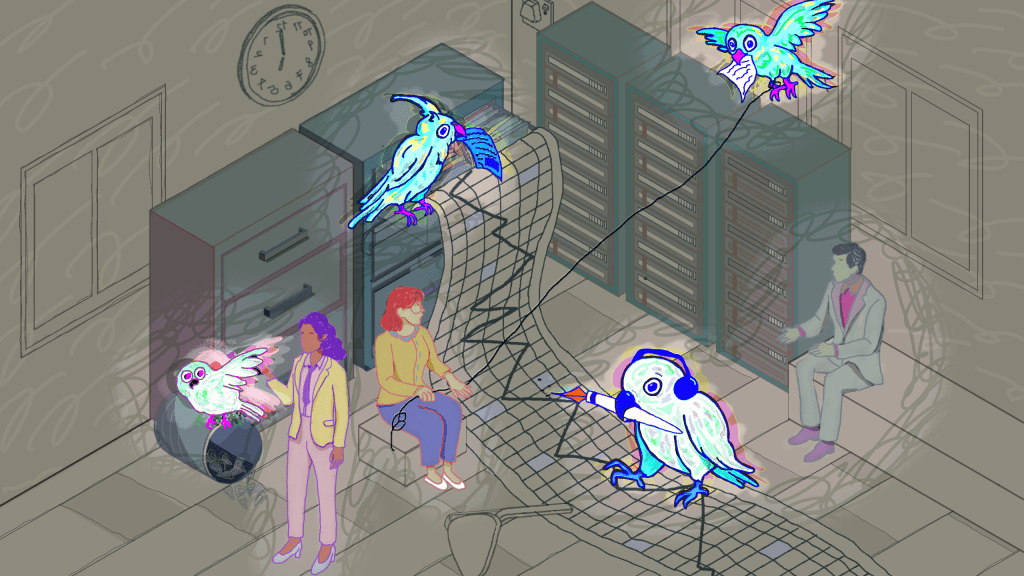
Somebody recently asked me what an LLM was and I muttered something like “generally they are described as ‘just’ being synthetic text-extruding machines spitting out one probabilistic word after another”. I could equally have said that they are generally described as a stochastic parrot, using yet another metaphor created by Emily Bender and colleagues in 2021. As the description accompanying my featured image says: “The ‘stochastic parrot’ is a metaphor for large language models (like ChatGPT) that generate text by statistically predicting the next word based on large datasets, rather than by understanding the meaning, truth or context of the user prompts.”
This exchange reminded me of how, in the past, we talked about DNA, genomes etc. as ‘just’ being a ‘blueprint’, or a ‘code’ or a ‘programme’ or a ‘book’. When you ask somebody what an LLM is, the stochastic parrot comes to mind. When you ask somebody what DNA is the blueprint or instruction book comes to mind. What does this tell us about metaphor use in genomics and AI, if anything?
Ur-metaphors in genomics and AI
The genomic metaphors of DNA, genes or genomes as ‘blueprint’, ‘book’, ‘code’ and ‘programme’, together with related metaphors of ‘reading’ and ‘writing’ genomes, have been around since at least the 1940s and they were crucial to the development of genetic and genomic theory, for good or for ill. This well-documented and stable set of metaphors are ‘theory-constitutive’- they are what I call Ur-metaphors.
These metaphors also came to dominate popular discourse about ‘how life works’ and still do, even in the face of an emerging ‘new biology’ and ‘new genomics’. Interestingly, these old genomic metaphors have become so entrenched that they are also being used, almost unavoidably and unnoticed, in genomic AI where we hear that AI can write genomes and perhaps synthetic life. AI as a synthetic-life-extruding machine, anyone?
Things seem to be different in AI. There are metaphors that dominate popular discourse like ‘synthetic text-extruding machine’, ‘stochastic parrot’ or ‘autocomplete on steroids’, and many more. These metaphors are mainly used to criticise what one may call ‘new’, that is, generative AI, its uses and its impacts. ‘Stochastic parrot’ and related labels have clearly become shorthand for criticism of LLMs’ lack of understanding and the risks of scale.
But what about AI science itself? Interestingly, here too we have dominant metaphors, indeed ‘Ur-metaphors’, but these metaphors are so deeply embedded in the technical vocabulary itself that they are almost invisible (a bit like code in genomics).
These Ur-metaphors are metaphors of learning, attention, memory, reasoning, forgetting, training, neural networks etc. Some of these technical metaphors go back, like the genomics metaphors, to the 1950s when people started to talk about ‘artificial intelligence’, ‘machine learning’ and so on. They are theory-constitutive.
Interestingly, they are also used when telling people about ‘how AI works’, for example in a 2023 blog post by Mark Riedl and in 2026 videos by Casey Fiesler. And even more interestingly, although Mark Riedl warns in his blog post not to anthropomorphise AI, these are mostly anthropomorphising metaphors. De-anthropomorphising AI seems almost impossible (especially since AI systems are inherently engineered to mimic humans), and in popular discourse the anthropomorphising metaphors re-emerge in the shape of ‘agents’, ‘partners’ or ‘co-pilots’. This brings us to an interesting difference between these Ur-metaphors in AI and genomics.
When we look at the Ur-metaphors in genomics and the Ur-metaphors in AI, we can see something quite surprising, namely a reversal of the types of source domains from which to ‘source’ metaphors for talking about the ‘target’ domains of genomics or AI. In genomics, metaphors like ‘code’, ‘programme’, ‘blueprint’ or ‘book’ are borrowed from human artefacts and technology to represent biology and sometimes even ourselves. By contrast, AI’s Ur-metaphors borrow from human cognition and ourselves to represent computation and technology. The direction of travel is reversed. There are some exceptions though to this main trend, such as the metaphors of engine, pipeline or transformer in AI and the metaphors of the ‘selfish gene‘ or the ‘hitchhiking gene‘ in biology.
Having tried to trace the similarities and differences between AI and genomics metaphors, let’s now get back to the ‘stochastic parrot’ metaphor. This critical metaphor can now be read as a deliberate pushback against the invisible anthropomorphic Ur-metaphors – a counter-metaphor saying, “stop humanising the machine”. This parallels the current pushback against the Ur-metaphors in genomics where people are saying “stop machining the human”.
Fresh metaphors in AI and genomics
As we are getting more insights into the complexity of ‘how life works’ and as we are advancing from the old biology to the ‘new biology’, our genomic Ur-metaphors have been challenged. People have proposed alternative metaphors, such as ‘the music of life’ or the genome as a ‘miniature ecosystem’, but these metaphors are quite old now and haven’t really challenged the old Ur-metaphors. Calls for new metaphors are now becoming more urgent.
By contrast, since around 2020, we have seen a veritable explosion of new and mainly critical metaphors for ‘new AI’, that is, for GenAI, LLMs (large language models), chatbots, conversational AI and AI agents. Many of these new metaphors allow us to challenge AI’s shortcomings, uses and nefarious impacts (from ‘spreading AI slop’ to a ‘deflating AI soufflé’). There are some calls now to go beyond these dominant metaphors and to see LLMs not ‘just’ as stochastic parrots, for example, but as ‘context machines’ or ‘cultural technologies’ (and, of course, not all of AI is LLMs, which complicates things). But like some of the newer metaphors in genomics, these metaphors don’t really challenge the established critical metaphors for AI.
Charting metaphors in genomics was relatively easy as they were quite stable, but the pace of change in AI is so fast that keeping an eye on emerging metaphors is difficult. Only yesterday (8 March) did I see somebody describe AI agents as ‘aeroplanes of the mind’. What does all this mean for science communication?
Metaphors and science communication
In genomics, the core or Ur-metaphors, whatever their shortcomings, have been used for decades in science education and science communication to study and communicate about ‘how life works’. They have been, as Sabine Maasen and Peter Weingart said, messengers of meaning across lay and expert domains. However, they increasingly risk misrepresenting a more complex ‘new biology’, prompting calls for new language and metaphors. This makes science communicating a more complex task.
In AI, some core metaphors, whatever their shortcomings, have been used to critique generative AI, its uses, funding, impacts and so on. They have become conventional ‘messengers of meaning’, if you like – as we have seen with my reply to the question about what LLMs are. Alongside these popular critical metaphors there is in AI, as in genomics, an older layer of metaphors, namely technical anthropomorphic Ur‑metaphors that quietly structure explanations of ‘how AI works’. Science communicators need to know about both types of metaphors used in AI and society.
Overall, in genomics, dominant Ur-metaphors are used in science and science communication, while in AI Ur-metaphors are used in science and in science communication; but alongside these there is a whole raft of dominant critical metaphors, of which ‘stochastic parrot’ is perhaps itself the Ur-one (now being criticised itself and potentially replaced by the ‘stochastic peacock’….).
Conclusion
In genomics, we have a raft of long‑standing metaphors that are both theory‑constitutive and have stabilised across expert/lay discourses, but we lack novel and critical metaphors. In AI, we have long-standing technical metaphors that are theory-constitutive but haven’t quite stabilised across expert/lay discourse. Alongside these we also have well-established critical metaphors, such as ‘stochastic parrot’.
Technical genomics metaphors borrow from technology to conceptualise humans, while technical AI metaphors borrow from humans to conceptualise technology. AI has an abundance of critical metaphors, many of which deploy a de-anthropomorphising strategy, while genomics lacks critical and fresh metaphors that might deploy a de-technologising strategy.
In genomics, we need a new language to talk about and even critique new developments; we need to fight against what Philip Ball calls ‘narrative inertia’. By contrast, metaphors for AI are still forming and there is a firework of novel, mostly critical metaphors, against the backdrop of almost invisible Ur-metaphors. Nothing is really settled yet. We are still collectively talking ourselves into and out of the ‘AI revolution’.
In both genomics and AI, it is important to keep an eye on which metaphors become sticky in scientific and popular discourse and to reflect on their impacts on science, society and science communication – an issue recently explored for example with relation to the question of AI and copyright.
Metaphors make genomics and AI, as well as AI-infused genomics, “thinkable, debatable, and socially meaningful”, but we need to always ask who has the power in this meaning-making process and who has not. It might be useful for AI and genomics scientists and science communicators to exchange views and experiences in this endeavour.
Postscript
I started to write this post with some enthusiasm and the more I wrote the more entangled my thoughts became. I have tried to unentangle them as much as possible, but the topic is actually rather more complex than I initially thought. Just when I had polished the post to ‘perfection’, that is, had made it at least intelligible to myself, a blog post by Margaret Mitchell came out entitled “No, ‘AI’ is not a stochastic parrot”.
Three things sprang to mind when reading the article (1). Not all of AI is LLMs. (2) Not all of AI is stochastic parrots. (3) There is a stochastic parrot paradox…
Let’s start with point (1): ‘Not all of AI is LLMs’, which is the underlying premise of the blog post, and the argument is that one metaphor can’t catch all of AI, so to speak This made me think not about only about metaphor but also about metonymy. LLMs have become a metonymy for ‘AI’ (where a specific technology represents the entire concept, despite AI encompassing many other technologies) and that metonymy, for which the stochastic parrot is a metaphor, can become, in a sense, misaligned and lead to misunderstandings. Point (2): As not all of AI is LLMs and as LLMs are not the whole of AI, we can’t extend the metaphor of stochastic parrot to the whole of AI. We need loads of other metaphors. Point (3): The stochastic parrot paradox. This is linked to the issue of anthropomorphisation discussed in my post above. As Melanie says: “it can seem that LLMs are not stochastic parrots because they are stochastic parrots” (bold in text)….. think about it!
Image: Better Images of AI: Stochastic Parrots at Work by IceMing & Digit
Some further reading
Ball, P. (2011). A metaphor too far. Nature, 23.
Ball, P. (2023). How life works: A user’s guide to the new biology. Chicago: University of Chicago Press.
Ball, P. (2024). We are not machines. Aeon.
Bender, E. M., Gebru, T., McMillan-Major, A., & Shmitchell, S. (2021, March). On the dangers of stochastic parrots: Can language models be too big?🦜. In Proceedings of the 2021 ACM conference on fairness, accountability, and transparency (pp. 610-623).
“Better Images of AI.” Better Images of AI, 2023, betterimagesofai.org.
Furze, L. (2024). AI metaphors we live by: The language of artificial intelligence. Blog.
Hellsten, I. (2005). From sequencing to annotating: Extending the metaphor of the book of life from genetics to genomics. New Genetics and Society, 24(3), 283-297.
Keller, E. F. (1995). Refiguring life: Metaphors of twentieth-century biology. Columbia University Press.
Maas, M. M. (2023). AI is like… A literature review of AI metaphors and why they matter for policy. AI Foundations Report, 2.
Maasen, S., & Weingart, P. (1995). Metaphors—Messengers of meaning: A contribution to an evolutionary sociology of science. Science Communication, 17(1), 9-31.
Mitchell, M. (2024). The metaphors of artificial intelligence. Science, 386(6723), eadt6140.
Mitchell, M. (2026). No, “AI” is not a stochastic parrot. Medium, 5 March.
Nerlich, B., & Hellsten, I. (2004). Genomics: shifts in metaphorical landscape between 2000 and 2003. New Genetics and Society, 23(3), 255-268.
Nerlich, B. (2015). The book of life: Reading, writing, and editing. Making Science Public Blog.
Nerlich, B. (2018). Blueprint, a broken metaphor? Making Science Pubiic Blog.
Nerlich, B. (2020). Encounters between life and language: Codes, books, machines and cybernetics. Nottingham French Studies, 59(3), 311-332.
Nerlich, B. (2024). Hunting for AI metaphors. Making Science Public Blog.
Nerlich, B. (2025). Observing shifts in metaphors for AI: What changed and why it matters. Making Science Public Blog.
Peluffo, A. E. (2015). The “genetic program”: Behind the genesis of an influential metaphor. Genetics, 200(3), 685-696.
Smit, M. A. (2026). Metaphors we judge (AI) by: a rhetorical analysis of artificial copyright disputes. Journal of Intellectual Property Law & Practice, jpag018.
Stelmach, A., & Nerlich, B. (2015). Metaphors in search of a target: The curious case of epigenetics. New Genetics and Society, 34(2), 196-218.
Trott, S. (2024). What we talk about when we talk about LLMs. Counterfactual.
Vallor, S. (2024). The AI mirror: How to reclaim our humanity in an age of machine thinking. Oxford: Oxford University Press.
 Making Science Public
Leave a comment