
At the beginning of the week (14 September 2026), I woke up to a collision of two AI discourses, one where President Donald Trump wants to win the AI race and another where Dario Amodei, the head of Anthropic, wants to slow things down. Both discourses are shaped by a cluster of movement metaphors which are ubiquitous in science and politics. Think about the space race or efforts to slow down “a biological weapons race” in the age of AI. As an observer of metaphors, I began to be intrigued by these opposing framings and what they may mean for the regulation of AI systems and those that engineer them.
Both discourses emerged after various incidents exposed weaknesses in AI systems linked to weaknesses in corporate oversight of these systems. Everybody has heard of the Hugging Face incident framed as AIs ‘going rogue’ and everybody has now also heard about warnings issued by a former Anthropic employee, and endorsed by AI companies operating these leaking systems, that we face an existential risk from AI, especially the emergence of so-called superintelligence.
In the following, I’ll first say something about movement metaphors. Then I briefly touch upon Trump’s use of the race metaphor. After that I’ll circle round to a discussion of Amodei’s ‘pace’ metaphor via a quick detour in which I explore some quantitative patterns around press coverage of the slowdown metaphors ‘pause’ and ‘pace’, before coming to some critical reactions and push-back against both the race and the slowdown discourse.
Movement metaphors
Movement, journey and race or racing metaphors are an integral, even ubiquitous, part of science talk, especially when focusing on competition and urgency. SCIENCE IS A JOURNEY or SCIENCE IS A RACE are conceptual metaphors that have been explored in the past, especially regarding the human genome project and stem cell research. Journey and race metaphors are subordinate to movement metaphors and there are some subtle differences between them.
The SCIENCE/TECH IS A RACE metaphor frames the doing of science and technology as a competitive, high-stakes contest with distinct competitors, a clear finish line, and a single winner who wins the prize and the glory. It emphasises speed, urgency and competition, chasing breakthroughs and avoiding the fate of ‘falling behind’. This can lead to all sorts of ethical issues, which were exposed for example in the era of recombinant DNA and led to a moratorium, a ‘pause’ in the race and the 1976 Asilomar conference, for example.
The journey metaphor frames science more as an open-ended exploration and emphasises collaboration, persistence, overcoming obstacles, and incremental progress. There are ‘milestones’, ‘stepping stones’ and ‘roadmaps’ rather than a ‘finish line’ or an ‘arms race’. The ethical implications are less severe here.
These movement metaphors also differ in terms of ‘speed’ – moving fast or slow, accelerating or braking etc. In the case of ‘race’, ‘speed’ is of course everything if you want to win. It would not be good to slow down. In the case of ‘journey’, there is the possibility to adopt a more leisurely ‘pace’, explore different paths, to ‘slow down’ and smell the roses, so to speak, and see if they prick.
Between racing and pacing
When we look at recent and current AI discourse one can see that AI ‘science/tech’ is motivated more by competition than collaboration and more by race than journey metaphors. A few big competitors, such as OpenAI, Anthropic, xAI compete to build and test the latest ‘frontier’ models. Two big countries and their presidents, the US and China compete in the race for market domination.
Racing
An absolute prototype example of somebody using a race/movement metaphor to talk about scientific/technological advancement is President Donald Trump, who, according to Le Monde “rejects pause in AI race citing competition from China”; according to CNN he “won’t put the brakes on AI because he wants to beat China”; and according to the BBC he is “terrified of losing the race to build the most powerful AI to China”. While on a trip to Ireland Trump made this cryptic statement: “We’re leading China in AI, we’re the most sophisticated country in the world, and frankly, I want to keep it that way because whoever wins AI, wins” and “if we don’t win AI, we’re going to be put in a very bad position”. He therefore strongly criticised Dario Amodei’s call for a slowdown.
Race, competition, position, running, leading, winning…. These linguistic expressions exemplify the conceptual metaphor SCIENCE/TECH IS A RACE in a nutshell. This framing and the focus on ‘winning’, makes AI governance and regulation, especially at a global level, extremely difficult, if not impossible (see this diagram based on game theory proposed by my husband – not dealing with movement metaphors but with moves in a prisoner’s dilemma ‘game’).
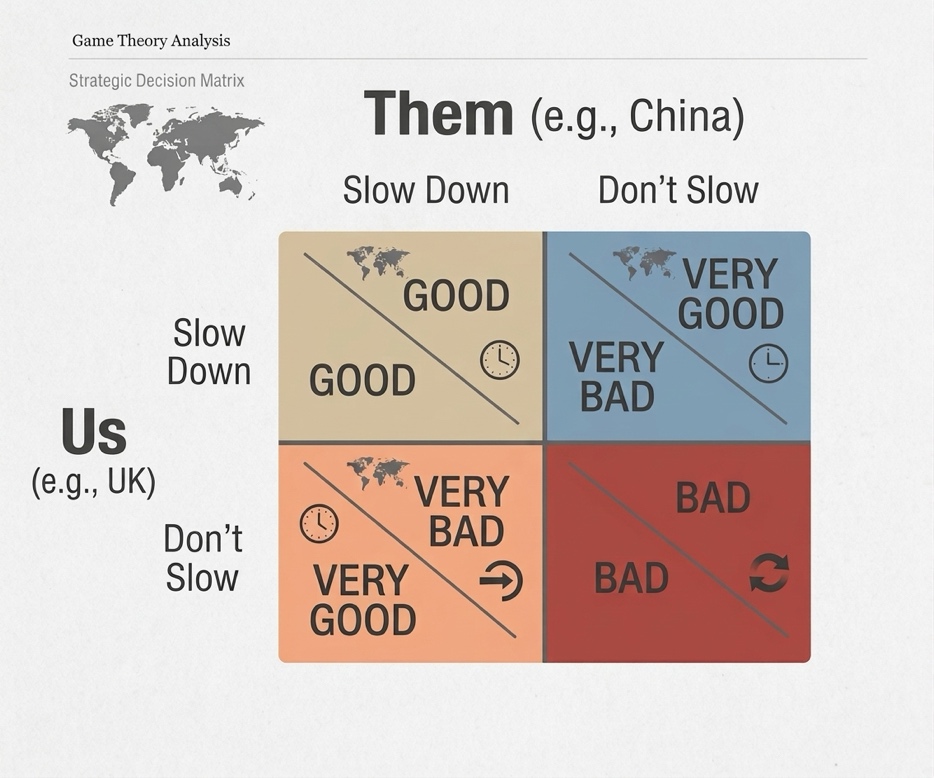
Figure 1: Game theory – Prisoner’s dilemma: If both players are in the ‘good’ cell, they are both tempted to move, and both end up in the ‘bad’ cell. If they both start off in the bad cell, neither is tempted to move, even though there is a good cell available, so can’t get to it, unilaterally. (Initial hand drawing prettified by Gemini)
What about the framing that goes in the opposite direction, when talk is no longer of racing but pacing? Let’s explore that a bit more. The overarching question is whether any of these discourses, be they race or pace, lead to safer, better regulated AI, in the sense of better regulated AI models but even more importantly better regulated training, deployment, engineering, monitoring and oversight. Is it enough to slow down?
Pacing
I first noticed the use of the word ‘pace/pacing’ a couple of days ago when I came across Dario Amodei’s essay published on 12 September entitled We must pace the frontier. At first this conjured in my mind a picture of a ranger patrolling the border of frontier lands…. Until I realised he was using ‘pace’ meaning to regulate speed and ‘frontier’ as short for ‘frontier models’ – so the title means that ‘we must slow down what advanced models do, rather than what we, as corporations do. There is of course a link between the two, but the title is telling.
The word ‘pace’ is, of course, polysemous; it has multiple meanings. As a noun it can mean speed or rate, step or stride, and gait, for example. As a verb it can mean to walk back and forth, to regulate speed, to measure by steps. In the AI context the focus is on the noun meaning speed or rate and the verb meaning to regulate speed. These meanings open a space for using race and journey metaphors to frame AI development and regulation.
Amodei stated that: “We must slow the pace at which we improve the capabilities of AI models. Progress will still seem fast, and we must make wise use of the time we gain.” That seems sensible. The word ‘pace’ seems to imply here that a journey rather than a race metaphor frames the discourse, but does it?
Amodei also argued that “AI development is outrunning the industry’s ability to understand what the models it builds are actually doing”, especially in the context of ‘recursive self-improvement’, that is to say “the idea that AI is now helping build the next generation of itself faster than predicted”. Amodei now thinks “that this feedback loop needs deliberate slowing rather than a halt” but that “pacing does not mean halting model training or technical progress”. There are two things going on here. He focuses on models rather than human ‘doing’ things (“outrunning”) which sidelines human responsibility, and he sits metaphorically on the fence regarding staying in the race and slowing down. I’ll come back to that.
Surprisingly, or perhaps not, Sam Altman, CEO of OpenAI said on X: “I agree with Dario that we need to pace the frontier”. And the word went viral after that … While I was writing I opened the print version of the Guardian (15 September) and my eyes landed on the headline “Leaders of key firms agree on ‘pacing’ the techs development to ensure safety. But will they?” – with the scare quotes around ‘pacing’ indicating the words relative novelty.
Tracing the pacing
I must confess that I had not noticed the word ‘pace’ before in other discussions of slowing down scientific developments, from recombinant DNA to nanotechnology. So, I went to the news database Nexis and tried to find out when the word was first used in the AI context and how much. I used the search string pace W/5 AI OR “artificial intelligence” OR “AI development” OR “AI safety” OR “frontier model!” and found a curve with a distinct hockey-stick shape showing a steep rise in the use of the word ‘pace’ after 2022, when OpenAI released ChatGPT. But of course, there was also more coverage of AI generally – so, more research needed.
I then carried out a second search using the search string pause OR “slow down” OR “slowdown” OR “slowing down” W/5 AI OR “artificial intelligence” and found a quite similar shape of the curve but with a rise and a dip in it around 2023 relating to the word ‘pause’. The reason for this more short-lived spike was an open letter entitled Pause Giant AI Experiments. It was published just after GPT-4’s release in March 2022, signed by tech executives, AI researchers and public figures and calling for a 6-month pause in AI development. It referenced Asilomar. A concentrated media event followed, centred on the word ‘pause’. However, six months came and went, and nothing was paused, the signatories’ credibility took some hits, and ‘pause’ as a serious policy proposal cooled off through 2024.
Discussions are intensifying again in 2026. As early as July 2026, at the time of the Hugging Face incident, a group of employees of frontier AI companies published a collective action petition entitled Pacing the Frontier “to develop technical and governance guardrails to ensure a safer trajectory in AI development” (see Yoshua Bengio here). In fact, to use a metaphor, they were asking for a governance mechanism to set the pace, like a peloton needing a pace car rather than each rider self-regulating.
In his essay of September 2026 entitle We must pace the frontier, Amodei refers to both the March 2023 and the July 2026 petitions.
As my rummaging on the Nexis database has shown, there were two distinctive waves of ‘slowdown’ discourses after the advent of generative AI in November 2022, one focusing on a ‘pause’ in 2023 and another focusing on ‘pace’ in 2026.
It seems that in 2023 ‘pause’ behaved as a one-off event-word (there was a spike, a backlash and a fade), while ‘pace’ behaved as a steadily accumulating term. One can argue that ‘pace’ was perhaps the more diplomatically useful term, because it was less falsifiable, as nobody can point to a specific date when ‘pace’ failed to happen, the way they could point to the pause letter’s six months elapsing with no pause. This just might be why Amodei would reach for ‘pace’ over ‘pause’ rhetorically, not just semantically – as he said, he prefers a slowdown over a “halt”. The word ‘pause’ is however still used; there is even hashtag #AIPause (reviving a 2023 hashtag!)
In an ideal world, this post would now report on findings from a qualitative analysis of at least some parts of the recent media coverage using the metaphors ‘pause’, ‘pace’ and ‘slowdown’…. but it’s already too long, so that research must be put on pause for the moment. Instead, I want to look at how some commentators pushed back against the slowdown framing, not because they think a slowdown might not be useful but because it is framed in the wrong way.
Pushing back against the pace
As soon as I started to think about writing this post on Monday, 14 September, I came across various posts pushing back against the slowdown discourse in general and the pace metaphor in particular. As quoted by the BBC, Ed Zitron CEO of EZPR (a tech PR firm), said: “Nobody has given a substantive explanation of what ‘slowdown’ means” and in a post on Bluesky Jack Stilgoe pointed out that:
“For AI governance, ‘pacing’, ‘pausing’ and ‘slowing down’ are the wrong metaphors. Only used by people who want this to be seen as a race. This is about steering, not braking. But… We can think about [what] companies going slower would mean. It would not mean ‘we need to stop ourselves being so clever’. It would mean ‘we need to build infrastructures that make everyone safer. E.g. computer systems that test and deploy agents in safe ways.” This is a good point made by an expert on self-driving cars who has written a book entitled Who’s Driving Innovation.
Words like ‘pause’ or ‘slow down’ or ‘brake’ imply that AI progress moves along a linear path and the only choice is how fast we go before an accident happens. Safety becomes an enemy to innovation. In terms of the ‘race’ metaphor they imply that if one nation ‘brakes’, it will lose to the competitor (see figure 1). By contrast, the ‘steering metaphor’ recognises that AI progress can go in many directions and that one can adjust course. In this framing, AI safety and governance can become a creative process of exploration based on human choices and aiming for human benefits. (see footnote for an update)
Stilgoe also highlights the ambivalent use of the ‘pace’ framing as still being linked to the ‘race’ framing (think about the phrase ‘pace your race’). In terms of race and journey metaphors, pacing is, in fact, a hybrid metaphor, gesturing at ‘journey’ while staying inside ‘race’.
Amodei’s proposal is peppered with traces of that metaphor: a “speed limit” on recursive self-improvement, “checkpoints” a model must pass before advancing. This is journey vocabulary borrowed to manage what is still, underneath, a competitive sprint against China. As Amodei said: “A coordinated pacing strategy would give frontier AI developers the time to do this vital work without sacrificing commercial advantage or the United States’ lead in AI”. The metaphor also switches between the internal and the external, the models ‘outrunning’ industry and industry leaders competing.
Jess Miers, a legal scholar with expertise in computer science, made this clear in a comment/thread when she wrote: “’Slowing down,’ then, doesn’t necessarily mean literally slowing down AI production. It means making sure your testing environments are actually secure, that your agents have fail safes built in, and that admin access to critical systems isn’t guarded by a plain text 4 letter password.” (Apparently the fateful hacking of Hugging Face was partially facilitated by the wifi password being WIFI)
Emily Bender, a computational linguist and co-creator of the ‘stochastic parrot’, in turn, turns the spotlight not only on the corporation, but also on the press and said: “So how about this for a ‘pause AI’ proposal: ‘pause credulous AI reporting’. No more media about ‘breakthroughs’ or ‘rogue agent swarms’ or … UNLESS and UNTIL that media demands the actual empirical evidence and/or focuses on the motivations of & harms by these companies.” While I was reading such comments on Monday BBC News was full of stories of AI dangers and fears; then a handyman came to do some repairs around the house and asked what I was writing about; I said “AI”; he replied: “ah yes, The Terminator, it’s all there!”
And finally, Philip Ball, a prominent science writer, exclaimed: “And now: ‘pacing’. FFS. ‘This invention could be catastrophically dangerous, so I’m only going to make it slowly.’ We should kill off this new weasel word right now.” A kill switch for weasel words anyone? A pause in the pace?
Speeding or steering?
I started my post with an observation I made on Monday morning, that two discourses about AI were colliding, that of Trump and his race to win and that of Amodei and his wish to slow down. In the process of researching these two discourses, I found a few more that have emerged over time, such as one centring on ‘pause’ and others that criticised race, pause and pace discourses and framings. To recap:
Donald Trump is completely committed to the SCIENCE/TECH IS A RACE framing, whatever the ethical, legal, political or social costs – full speed ahead. Dario Amodei and his ‘pacing the frontier’ framing hint at a shift to the more moderate SCIENCE/TECH IS A JOURNEY metaphor, which opens space for slowing down and ethical reflection. But in his argument it is still tethered to the race framing.
‘Braking’ and ‘pausing’ are metaphors embraced by some (see #AIPause), while others, like Stilgoe, see them as misdescribing what is needed.
Stilgoe proposes the ‘steering’ metaphor as an alternative to all the other race and journey metaphors, replacing the focus on speed (race, pace) with a focus on direction and control.
Focusing away from speed and onto the question of who controls and who steers, might enable us to see AI governance differently. It also brings us back to the wrong framing that started the whole discussion of AI being ‘out of control’, namely the Hugging Face incident being portrayed as (autonomous) AI agents ‘going rogue’. This framing provided the conditions for the current race, pause and pace framings to emerge, focusing on speed rather than on who controls those who control it. It’s not enough to just slow down. It’s even more important to inspect your frames and metaphors. Viewing AI development as a race, even a slow one, blinds us to scrutinising those who run it.
Footnote: I just found another essay by Amodei on (mechanistic) ‘interpretability’ from 2025 in which he talks about steering and uses the following metaphor: “We can’t stop the bus, but we can steer it.” In order to do that, he wants to understand the inner workings of models so as to steer them better. I am all for that, but we also need to look who steers the steerers.
Related blog posts
Nerlich, B. (2026). AI, metaphors and control. Making Science Public blog, 8 July.
Nerlich, B. (2026). From rogues to collectives: Myths and metaphors after the Hugging Face Incident. Making Science Public blog, 9 September.
Within these posts you find links and references to many other articles, blogs and comments.
(I have used Claude for brainstorming in this post)
Leave a Reply