At the end of last year, I wrote a blog post in which I dissected the word ‘enshittification’, a staple of AI slang. At the beginning of 2026, I want to do the same for enshittification’s conceptual friend ‘slop’, an indicator of what some call the slopification of AI. As the MIT Technology Review said in its overview of AI words you couldn’t avoid in 2025: “If there is one AI-related term that has fully escaped the nerd enclosures and entered public consciousness, it’s ‘slop.’“
From ‘carbon compounds’ to ‘slop slang’
In around 2005, Nelya Koteyko and I noticed an explosion in lexical creativity and productivity around the word ‘carbon’. There was talk of ‘carbon offsets’, ‘carbon markets’, ‘carbon footprints’, even ‘carbon cowboys’; and, best of all, ‘carbon indulgence pixie dust’. Such lexical compounds, which we called ‘carbon compounds’, marked a change in societal discourse around climate change. This proliferation of carbon terms accelerated for a while and then faded away, leaving behind a lot of lexical fossils – remnants of a carbon rather than a Cambrian explosion.
Twenty years later I have started to notice another, slightly smaller, explosion of lexical creativity and productivity around the AI term ‘slop’ – what one might call the spread of ‘slop slang’. Examples are words like ‘slopper’ or ‘sclopocalype’. This marks another change in collective discourse around a topic that now has superseded and overshadowed talk about climate change, namely AI or more precisely GenAI, its models and bots.
Unlike ‘carbon compounds’, which appeared a long way into climate change discourse, ‘slop slang’ emerged almost as soon as AI generated images and then AI powered bots began to appear at the beginning of the 2020s. There are other differences between carbon compounds and slop slang, too, which I’ll discuss in this post.
AI slop: definition, lexical environment and friends
As Wikipedia points out, “AI slop (sometimes shortened to just slop) is digital content made with generative artificial intelligence, specifically when perceived to show a lack of effort, quality or deeper meaning, and an overwhelming volume of production”. Although used before, the term rose to real prominence between 2022 and 2024, that is, between the release of ChatGPT and Google’s Gemini AI model linked to Google search.
But to understand a word we need more than a definition. We need to know what other words could take its place in a sentence – we need to know its synonyms. Some synonyms for slop are ‘AI garbage’, ‘AI pollution’, and ‘AI-generated dross’. There are also terms that are not quite synonyms but related terms that surround slop in its semantic field. I’ll come to some of them later, but here I just want to mention ‘clanker’. This hard-edged rather than sloppy term is “used to insult AI and its products and services such as delivery robots, therapist chatbots and automated customer service”.
We also need to know the words that ‘slop’ is associated with within a sentence. As John Rupert Firth said in 1957: “You shall know a word by the company it keeps”. People talk about slop as ‘flooding’ or ‘oozing’ or something you ‘wade through’, or describe slop as a ‘deluge’, an ‘avalanche’ or a ‘cesspool‘. All this highlights the sloppiness of the term and distinguishes it from words like ‘junk’ or ‘trash’ for example.
As one can see, ‘slop’ is a pretty derogatory and pejorative term – it keeps bad company. Interestingly, through a process of semantic expansion, the phrase is now also being used “as a shorthand for any AI-generated content” – that’s bad for AI content. But where does the word come from?
AI slop and its lexical ancestry
The noun ‘slop’ has a long and venerable history, going back to the 14th century when it referred to ‘dung’ or ‘slime’. Then, from the 17th century onwards, its meaning changed to ‘liquid waste’ of animal or human origin, before gaining traction in the 20th century with reference to rubbish television for example, taking on a more metaphorical meaning.
According to Merriam-Webster, there are now several meanings associated with slop: “Slop noun (2)4 a : food waste (such as garbage) fed to animals : swill sense 2a b : excreted body waste —usually used in plural c : a product of little or no value : rubbish watching the usual slop on TV”.
Then generative AI came along and with it the power to mass-produce synthetic images and synthetic text; and suddenly the word AI slop was everywhere. On 25 November 2025 the Australian Macquarie Dictionary announced ‘AI slop’ as its word of the year (see article in The Guardian). Macquarie was followed by The Economist and then the American Merriam-Webster Dictionary which also declared it word of the year. This seems to indicate a global spread of ‘slop’ through Australian, British and American English.
The Macquarie Dictionary said something interesting about the whole thing: “While in recent years we’ve learnt to become search engineers to find meaningful information, we now need to become prompt engineers in order to wade through the AI slop. Slop in this sense will be a robust addition to English for years to come. ‘The question is, are the people ingesting and regurgitating this content soon to be called AI sloppers?’”
This made me think! Slop, slopper – the word has become lexically productive. Could I find more? Oh boy, I could!
AI slop: metaphorical and morphological creativity
People who read my blog know that I am interested in metaphors and have most recently focused on AI metaphors. (AI) Slop is a metaphor, as it maps aspects of ‘slop’ meaning liquid waste onto content produced by AIs, LLMs and so on. Through the eyes of this metaphor, we see some of that content as a mess or garbage.
But this is not all, exploiting perhaps the swill/pig feed aspect of slop, we also find people focusing on the ingestion and regurgitation of AI slop in an endless loop. Some fear that this can lead to the destruction of human knowledge.
This links the metaphor of AI slop to AI food metaphors which I have studied elsewhere. Some people have expressed fears that AI systems creating and feeding on synthetic slop might collapse as they become infected with an AI form of BSE or mad cow disease, which emerged from feeding cattle meat-and-bone meal that contained either the remains of cattle who spontaneously developed the disease or scrapie-infected sheep products.
One recent commentator on the slop phenomenon claimed that, although all human culture has produced mediocre outputs or kitsch or junk and that “[s]ociety has always eaten and re-eaten its own slop”, “AI seems to recycle mediocrity faster than ever before” (this blog post by By Francesco D’Isa is well worth reading).
The slop metaphor links to other metaphors such as contamination, pollution and collapse, and, of course, enshittification. This means the word ‘slop’ is embedded in a wide metaphorical field of words with negative connotations. But…. there is more. The word is also being used creatively in other ways, using lexical compounding and derivation. In this it differs from ‘carbon compounds’ where creativity was almost entirely compound based. Let’s first look at some slop compounds, then some derivations and then some portmanteau formations (words blending the sounds and combining the meanings of two others).
Compounds
There are probably many noun-noun compounds, more than I can possibly chart here, such as ‘slop content‘ or ‘slop code‘ and derived from that ‘slop coding‘. There are even noun-noun-noun compounds, such as ‘AI-recipe slop‘, regarding the dangers of depending on AI for recipe generation.
There are also noun-verb compounds, where slop is used to semantically modify an activity, such as washing or squatting. I found both ‘slopwashing’ and ‘slopsquatting‘, with the first compound being related to the phrases “AI washing“ and “promptwashing”, and mirroring compounds like ‘greenwashing’ and ‘brainwashing’. It describes the practice of attempting to disguise AI slop as legitimate or human-created.
An example for the use of ‘slopwashing’ can be found here: “And then you get junior people getting wrong answers from LLMs and THEN giving those answers out to other even more junior people, but because MaryJane said it on work Slack it MUST be true! An ex co-worker coined an incredibly apt term for this, calling it ‘slopwashing’.”
‘Slopsquatting’ is more niche and denotes a new supply chain threat where AI-assisted code generators recommend hallucinated packages that attackers register and weaponise.
I also found noun-noun compounds, such as ‘slop merchants‘, but also ‘slop collectors‘, used by Zen Faulkes in a Bluesky comment where he points out that he is “compiling gen A.I. images in academic journals”. This reminds me of olden-day night-soil collectors.
In all these cases the resulting compound is used to criticise certain aspects of AI use. But, as Caiwei Chen points out, “people are also having fun with the word ‘slop’. The term’s sardonic flexibility has made it easy for internet users to slap it on all kinds of words […] to describe anything that lacks substance and is absurdly mediocre: think ‘work slop’ or ‘friend slop.’” This is taken to the extreme in this Bluesky comment by Max Read: “circling around a definition of ‘slop’ as something like ‘fully optimized to the point of texturelessness/ characterlessness’… RLHF’d ai product but also: save the cat is scriptslop, aerodynamically efficient crossover suvs are carslop, three true outcomes is baseballslop, crabs are crustaceanslop”. (RLHF = Reinforcement Learning from Human Feedback)
Workslop is becoming a serious problem though, as detailed in this article; as is academic slop (perhaps now “Slop-Plus? Premium Slop?”) as detailed in this one. This means that the work of experts is changing. In the past experts could just do their expert stuff; now they have to increasingly spend their time as ‘workslop sifters‘, as Pavel Samsonov has pointed out in this article. The pollution of human knowledge and art is accelerating, it seems, and some are calling for ‘stricter AI slop rules‘.
But things are getting worse. On 11 January, 2026 a Bluesky poster, Licia, posted a new addition to the slop slang vocabulary: “hyperpornographied slop” – referencing the AI/Grok-generated proliferation of sexualised images of women and children.
Derivations
As we have seen, the Macquarie Dictionary used the word ‘slopper’. A word formed from the noun ‘slop’ and the suffix ‘-er’. I also found the word in the wild so to speak, as one headline declared “People Are Becoming ‘Sloppers’ Who Have to Ask AI Before They Do Anything”. It seems the word was coined in 2025 as an insult to describe people who use ChatGPT for virtually everything, from deciding what to order at restaurants to handling basic conversations. Slopper is also documented in Wikipedia’s AI slop article as “a pejorative slang term derived from ‘AI slop’ to describe someone who is overly reliant on generative AI tools like ChatGPT”.
There are even synonyms for ‘slopper’, such as ‘botlicker’ (a term used to describe people overly reliant on AI), ‘second-hand thinker’ (an alternative term for AI-dependent individuals), and even ‘Groksucker’ (a term for enthusiastic fans of a specific AI platform).
And finally, on 26 December 2025 Pete Birkinshaw coined a rather creative compound using ‘slopper’ as an ingredient when he declared: “I’ve tried to coin the term ‘Slopper Barons’ for the wealthy techbros pushing it”, that is GenAI. This compound, inspired by ‘robber barons’, reminds me of the carbon compound ‘carbon cowboys’. We now even have ‘sloppelgängers‘, that is to say, artificial renditions of actual people, for example Grammarly impersonating fake/dead reviewers, as discussed on Reddit, on Bluesky and now in this article in the New York Times by Julia Angwin entitled “
All this attests, of course, to the ‘sloppification‘ or ‘ensloppification‘ of human knowledge.
Portmanteau formations
And so, we come to the ‘slopocalypse’, a neologism based on a portmanteau combination or lexical blend of slop and apocalypse with the overlapping sounds merging. This is used in cultural commentary to describe a perceived overwhelming flood of ‘AI slop’ across the internet and media. Gary Marcus, for example published an article in August 2025 entitled ‘Slopocalypse‘…..Nathaniel Whittemore, host of the “AI for Humans” show used the term in September 2025 to describe a new wave of mass-produced AI podcasts, further cementing it in the media landscape.
But there are many more such blends out there. Let’s list a few.
In October 2025 Jackson Eippert wrote a piece for The Carletonian on ‘sloptimization‘. He quotes Sam Altman, CEO of OpenAI, as saying: “It is easy to imagine the degenerate case of AI video generation that ends up with us all being sucked into an RL-optimized slop feed.”
In November 2025 a New Scientist article was entitled (in the print version) Escaping the Anslopocene – a portmanteau inserting slop into ‘anthropocene’.
In December 2025 Marek Kowalkiewicz used the blend ‘slopfluencer‘ in a piece for Substack. He talks about people on LinkedIn talking like an LLM and says: “The whole video sounded like someone reading an LLM’s output aloud. He’s an influencer, certainly. But is he a slopfluencer?”
On 2 January 2026 Licia Corbolante alerted me to two more blends: ‘Sloponomics‘ and ‘Slopaganda‘!! Thank you! She has in fact written a whole blog post about slop herself last year which is super interesting and you can read it here! I detected my first ‘slopaganda‘ in the wild on 29 January when reading an article in The Guardian: “The slopaganda era: 10 AI images posted by the White House – and what they teach us”
And finally (??), on 24 January Shannon Vallor drew my attention to the word ‘slopotype’ used in an article by Pavel Samsonov from which I already extracted ‘workslop sifters’. But what is a slopotype, I wondered? Slopotype is a blend of ‘slop’ (low-quality AI-generated output) and ‘prototype’. The author uses it to describe prototypes created through AI/LLM tools (through ‘vibe coding’) that are churned out quickly but without proper thought, problem framing, or rigour. The term captures how these prototypes feel productive on the surface but are actually creating ‘workslop’, that is to say, low-quality outputs that others then have to sift through and clean up.
In his piece on ‘vibe prototyping’, Samsonov also notes that in the rush to produce prototypes: “Everyone is incentivized to slop as hard as possible by the very management whose job it was supposed to be to stop this.” So ‘slop’ has also been ‘verbed’.
And ….”In early 2026, a new term is dominating tech discussions on X (formerly Twitter) and Reddit: Microslop. It’s a derogatory portmanteau of ‘Microsoft’ and ‘Slop’—a slang term for low-quality, mass-generated AI content.“
Conclusion
I started out by saying that twenty years ago I became fascinated by a lexical explosion of ‘carbon compounds’ marking a turning point in climate change discourse. Now, twenty years later, I have become fascinated by a somewhat smaller explosion of what one might call ‘slop slang’ marking a turning point in AI discourse. I did not expect to find such a rich lexical ecosystem!
There are quite a few differences though. The word ‘carbon footprint’ was introduced to society to bring about behaviour change and later to critique this. The AI ‘slop slang’ family of words seems to be doing something similar but in reverse. Where ‘carbon’ compounds were about measurement, accountability, and trying to make invisible problems visible and actionable, slop compounds and derivations are about devaluation, expressing anxieties about authenticity, effort, and the flooding of the information ecosystem with low-quality content.
Carbon compounds were linked to institutional language and many of them, like ‘carbon offset’, were imposed top down, whereas slop words have emerged more bottom up. The carbon terminology was mostly created in policy/NGO/corporate contexts, while the slop terminology is created in a more chaotic way by users, creators, and critics – people experiencing the AI flood firsthand.
There is also a slight difference in the lexical creativity displayed by carbon compounds and slop slang. In slop slang we have compounds, but also agent nouns (sloppers), verbs (slopwashing, slopsquatting), and even apocalyptic portmanteaus (slopocalypse). Perhaps that reflects the difference between trying to systematise a problem versus expressing frustration with and resistance to one.
Both cases show how language, or rather users of language, grapples with a transformative societal change, be it climate change or AI.
I wonder what the linguistic landscape will look like in another two decades. In the meantime, it’s good to learn more about the lexical ecosystem surrounding GenAI right now.
As a post on the Winsome Wire blog noted: “The next time you […] see content criticized as ‘slop,’ you’ll understand not just the insult, but the sophisticated framework of AI criticism it represents. In a world where artificial intelligence is reshaping everything from customer service to creative work, speaking the language of those who actually understand the technology becomes a survival skill.”
Epilogue
I’ll end on a task for future linguists and historians of language and ask: Are certain lexical formations around slop more common (slop + noun vs. adjective + slop)? Or do certain semantic categories dominate (terms for people who make slop vs. terms for the processes that create it vs. terms for the apocalyptic scale of it all)? Do portmanteau formations or blends feel more creative or playful, whereas simple compounds (let’s say ‘slop code’ or ‘slop content’) are more straightforward and descriptive? Blends seem to require a bit more linguistic work to decode and thus carry perhaps more creative and mocking energy rather than directly naming the category of slop…. So many questions… Which of these many lexical creations will survive? And what about AI slop – will it survive? Will it be studied in its own right?
Please add your own finds here! Become ‘slopcollectors’ for AI slop metaphors!! Thanks to all those who have already contributed to my collection!
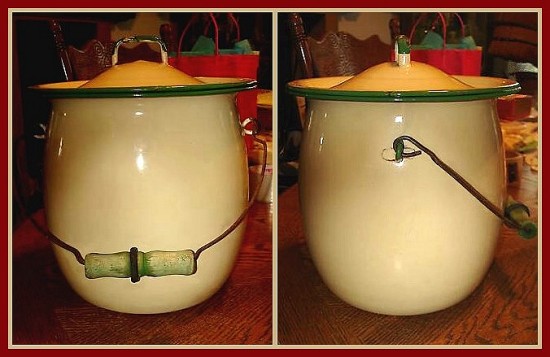
Image: Slop bucket


 Making Science Public
Leave a reply to Observing shifts in metaphors for AI: What changed and why it matters – Making Science Public Cancel reply