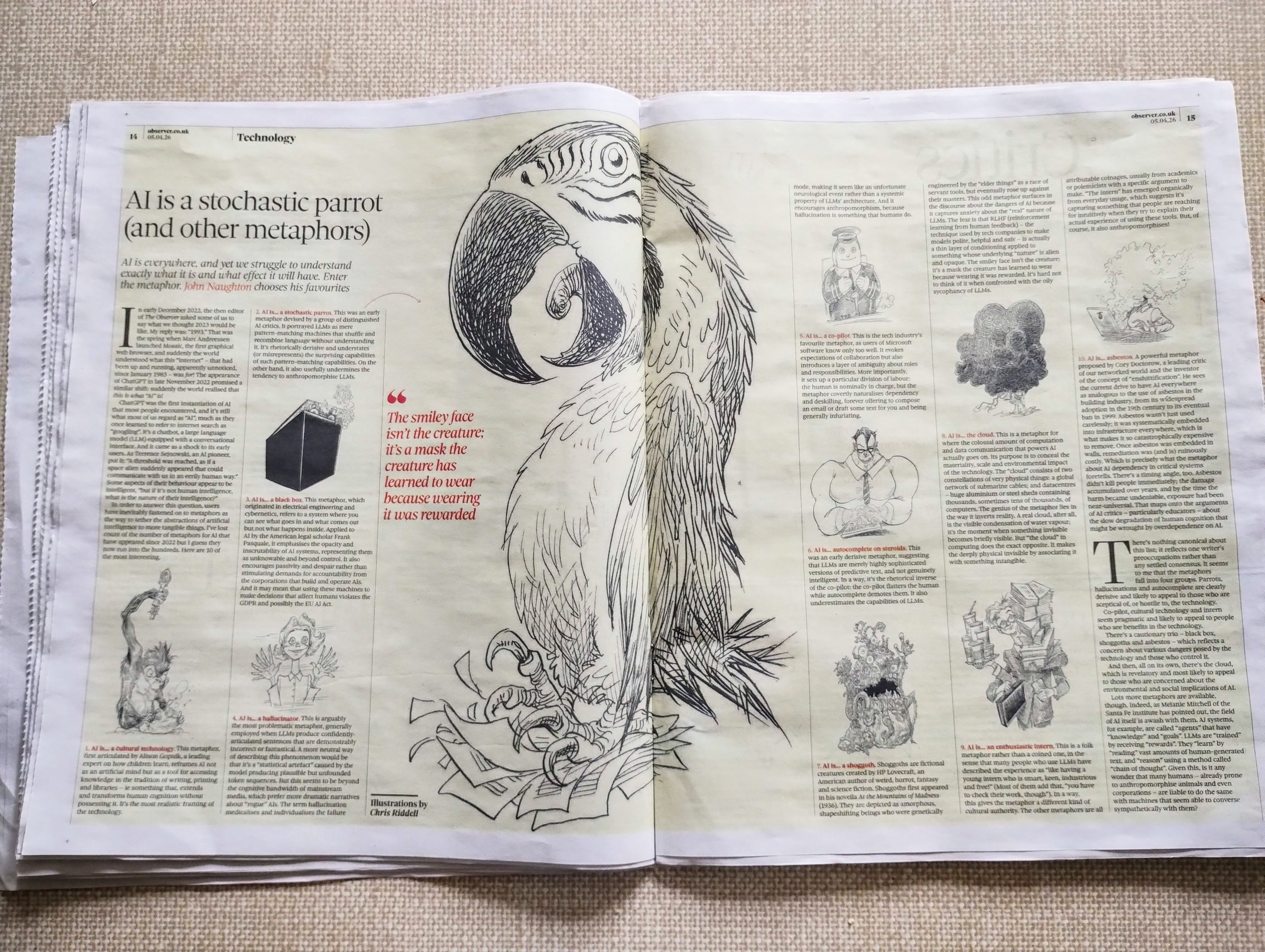
This morning, I opened Bluesky and saw a message from Matthew Cobb alerting me to an article in The Observer on “Ten metaphors for AI” by John Naughton. Metaphors for AI, c’est moi, I thought, and indeed in the online version there is a link to one of my posts. Wow. At the same time I a heard the actual Observer plop through our letter box. I sat down at the kitchen table with a cup of coffee, the Observer and a toasted hot cross bun and started to read it.
As it is Easter, we had visitors, who came down for coffee too. They looked over my shoulder at the newspaper. One of them, upon seeing the phrase “AI is… a cultural technology” as a first example of a ‘metaphor for AI’, immediately said, but “no, that is not a metaphor”; and another quipped, “fire is a cultural technology”; and a third one chipped in by claiming that “language is a cultural technology” After that we tied ourselves in knots about what was literally or metaphorically a cultural technology or not.
So, here is my take on how to disentangle that knot. I’ll first disentangle things in the abstract, as we did when we all just glanced briefly at the article on the kitchen table and started to chat. I’ll then put the phrase “AI is… a cultural technology”, a framing first articulated by Alison Gopnik, in its context and say why it makes sense in that context.
Metaphor or not that is the question
I think one can distinguish between various levels of literalness (or metaphor) when applying the phrase ‘cultural technology’ (source domain) to talk about other things like fire, language and AI (target domain).
When I say ‘language is a technology’ I use a metaphor. I sometimes even say, using a metaphor that ‘metaphor is a technology’ – like fire and you must be careful how to use it and how not to get burned.
When I say ‘language is a cultural technology’ (or indeed ‘metaphor is a cultural technology’), I am still using a metaphor but it’s slightly attenuated by the word ‘cultural’. ‘Language is a cultural technology’ is a metaphor, because ‘technology’ is doing a conceptual stretch. Language is not built, it has no hardware, no inventor. The word ‘technology’ is being borrowed to capture something about how language functions as a tool – how we do things with words.
When I say ‘fire is a cultural technology’ that sits in the middle. Fire is a natural phenomenon that becomes a cultural technology through control and use. The technology is in the human relationship with it more than the thing itself.
When I say ‘AI is a cultural technology’, I am using this sentence literally on both counts. AI is unambiguously a technology, and it is unambiguously cultural, all the way down. Having said that, one might argue that ‘cultural technology’ is itself a metaphorical concept, but I think that wouldn’t really get us very far.
The ‘metaphor’ in context
Having disentangled our breakfast discussion about AI, language and fire, it’s now time to go back and ask: Is ‘AI is a cultural technology’ really a metaphor? I think the answer is no. But to get a better answer, let’s look at the context in which that statement was made – it’s always good to look at the context.
John Naughton wrote: “AI is… a cultural technology. This metaphor, first articulated by Alison Gopnik, a leading expert on how children learn, reframes AI not as an artificial mind but as a tool for accessing knowledge in the tradition of writing, printing and libraries – ie something that, extends and transforms human cognition without possessing it. It’s the most realistic framing of the technology.”
Here ‘cultural technology’ is opposed to ‘mind’. And that opposition makes a difference. But in mind, it is a difference in ‘framing’ (as Naughton says himself ‘realistic framing’) rather than metaphor. What we have here is Alison Gopnik, a developmental psychologist, reframing AI and opening up space for new discussions.
Framing AI as a ‘cultural technology’ usefully highlights that it is neither a neutral force of nature nor a superintelligent mind, but a human artefact embedded in cultural assumptions, values and power structures. Unlike language which emerges organically over centuries without a designer and owner and belongs to everyone who speaks it, AI is designed, owned and not distributed in a commons-like fashion. This ‘framing’ rather than ‘metaphor’ can be useful as a critical tool for thinking about a lot of other, especially anthropomorphising, metaphors of AI as a mind or a genius. If we see AI as just another powerful cultural technology, we can ask who shapes it, whose values it encodes, what it makes easier or harder to do or to think.
This framing provides people who worry about the impacts of AI’s effects on culture with a tool to think with. It places AI in a long line of other cultural technologies that were transforming rather than necessarily destructive. Fire, used wisely, can enhance culture through cooking. Printing, used wisely, can enhance culture through enabling people to read other people’s thoughts. AI as a cultural technology, used wisely, can….. fill in your own thoughts 😉 I’d love to hear some examples….
***
This was just a quick little post that came out of a kitchen-table discussion. On Friday, in my usual spot, I’ll talk about ‘Habsburg AI’, a metaphor that highlights the negative cultural consequences of AI — when, to use a real metaphor, AI becomes a ‘calcifying technology’.
Image: Observer article on metaphors for AI spread on kitchen table. I love the Illustrations by Chris Riddell!!
Leave a Reply