On 22 September 2026, at the UN General Assembly, President Trump announced that the United States “totally rejects” any attempt to construct a global scheme to control artificial intelligence, and then did something that no linguist can ignore: he renamed it. “The use of the word artificial makes intelligence sound fake,” he said. “It is not fake. It’s actually amazing.” From now on, he continued, US documents “and hopefully the world’s” would use “the much more accurate term super as opposed to artificial”. “Welcome to the new world of super intelligence – SI,” he said. “Let’s see if that goes.” (Quotations as reported by The Hill.) A week later, according to The Next Web, an executive order told federal agencies to follow suit. Like ‘fake’ news, ‘fake’ intelligence was cast out of the White House.
The timing is uncanny. For a while now, I had been preparing a post about three adjectives that all, in one way or another, mean ‘human-made’, and about what the choice of adjective does to the noun it modifies. But I had put off posting it because of other AI stuff being more topical. The president’s announcement turns what I had treated as a rather academic exercise into a live experiment: what happens when a word is changed by decree? I come back to that near the end.
Over the summer I had gathered some of the blog posts I have written since 2012 and wove them together into three large anthologies dealing with anthropogenic climate change, synthetic biology and artificial intelligence. The other day, well before the Trump announcement, I was reflecting on these themes when it occurred to me that they all deal with ‘man-made’, or rather ‘human-made’, phenomena. I began to wonder: what do these three adjective-noun compounds mean and what may their role be in science communication?
I’ll first provide a brief overview of what we are talking about when we say the words ‘anthropogenic climate change’, ‘synthetic biology’ and ‘artificial intelligence’; I’ll then examine the semantics of the adjectives ‘anthropogenic’, ‘synthetic’ and ‘artificial’; and then tease out their connotations and implications in the context of the nouns they modify. Finally, I’ll turn to what happens when someone tries to deliberately replace one of these words.
Basic meanings
Anthropogenic climate change
The Oxford English Dictionary (OED) defines ‘anthropogenic’ as “originating in or caused by human activities”. One of its earliest illustrative citations, from a 1976 issue of Science was a bit of a surprise: “Anthropogenic gases may alter our climate by plugging an atmospheric window for escaping thermal radiation.” I hadn’t come across that image of the greenhouse effect before — a plugged window. Nice!
Anthropogenic climate change itself needs little introduction: long-term shifts in the Earth’s weather and temperature caused, directly or indirectly, by human activity, predominantly the burning of fossil fuels. Not nice!
Synthetic biology
The OED offers two relevant senses of ‘synthetic’, but, surprisingly, doesn’t yet have an entry for the compound ‘synthetic biology’ itself. Of a substance, synthetic can mean made by chemical synthesis in imitation of something natural, or, of a fibre or fabric, made from artificial rather than natural materials. Figuratively, it can simply mean artificial, imitation, invented, even… unnatural.
Synthetic biology, as a field, applies engineering principles to biology: designing and building new biological parts and systems, or redesigning existing ones. Some scientists and industry writers have long worried that ‘synthetic’ smuggles in connotations of fake, unnatural, or dangerous, and have reached for alternatives like ‘engineering biology‘ instead.
Artificial intelligence
Unlike the other two, ‘artificial intelligence’ gets an entry all to itself in the OED. The compound is fully lexicalised and has been in use since 1955, in the proposal for what became the 1956 Dartmouth conference. The OED’s definition highlights the capacity of computers to exhibit or simulate intelligent behaviour, later extended to software performing tasks, especially via machine learning on large datasets, previously thought to require human intelligence. It even refers explicitly to ‘generative artificial intelligence’, a phrase first recorded in 2001.
‘Artificial’ has the longer and more interesting history of the three adjectives discussed here. From the sixteenth century onward it could refer to “anything made in imitation of, or as a substitute for, what is natural” (light, tears, teeth, flowers), with the sense “fictitious, not genuine” following in the 1640s, and “full of affectation, insincere” earlier still, in the 1590s. So imitation, insincerity, and fabrication were all part of the meaning of the word more than three centuries before anyone thought to attach it to a machine.
Roots and Forms
All three words modify the noun they go with in certain ways and are themselves built in certain ways – they have different origins and morphologies.
Like so many of our English words, anthropogenic has Greek roots in anthropos meaning human being and genic meaning born or produced, with the adjectival suffix -ic being ‘pertaining to’ or ‘caused by’. Morphologically it is built like a diagnosis (carcinogenic, pathogenic, allergenic all share that suffix). Anthropogenic is a causation word and together with climate change it means human-caused climate change.
Synthetic too has Greek roots and comes from syn–tithenai, ‘to put together’. The word foregrounds assembly, composition, parts. It is a construction word. It refers to building or designing biological parts and wholes.
Unlike the other two words, artificial is rooted in Latin. It is the oldest and vaguest of the three and brings together ars or art and facere to make, resulting in the meaning ‘made by art or skill’. It is a fabrication word*. In the case of AI in the modern sense of GenAI, we are dealing with the fabrication of text, images and codes. The machine system that makes them is human-made but the outputs are imitations or simulations of human-made and human-thought things. In a sense, “AI is NOT Artificial – it is made of material goods, labour, and societal infrastructure”.
The three words encode different relationships to the human-made thing: caused, assembled, and fabricated or imitated.
Connotations and implications
I’ll first look at the connotations of these words, or the emotional, cultural, or hidden ideas associated with them, and then at their implications in terms of what feelings and possible attitudes they may evoke.
Although a highly scientific term, ‘anthropogenic’ is now a word surrounded almost entirely by feelings of guilt and blame. It assigns responsibility and condemnation. Its connotations are almost entirely negative.
‘Synthetic‘ is more ambivalent. In consumer contexts (synthetic fibres, synthetic flavouring) the word is semantically associated with something that is fake or inferior, but it was initially reclaimed as a positive engineering identity for synthetic biology, evoking the ‘we build’ ethos aligned with the BioBricks/DIY-bio maker movement, for example. However, while I was working as a social scientist in this field, scientists were sometimes uneasy about the term and asked us social scientists/linguists to come up with a better one, something that wouldn’t make it sound so artificial and unnatural. Recently, the word ‘engineering biology‘ has been used to get away from ‘synthetic biology’, although in my mind this can’t really change perceptions as the phrase echoes the rather contested one of ‘genetic engineering’ and scientists playing God.
‘Artificial‘ has what one might call an even stronger negative charge, carrying the connotation of fake or inferior in everyday language. Think of artificial sweeteners, artificial flowers, artificial turf and so on. And yet, the AI industry ran with the word and kept it rather than fighting it the way synthetic biology did. It is not quite clear to me why ‘artificial’ survived for so long as the industry’s own self-description when its basic connotation is ‘not the real thing’, while synthetic biology at least gestured towards an alternative. Until now, that is: that very connotation is what President Trump has just said he objects to (see below).
Some AI critics have proposed alternatives, such as “synthetic agent“, but like ‘engineering biology’ for ‘synthetic biology’ that gets us into a whole lot of different trouble, relating to the words ‘synthetic’ and the anthropomorphic ‘agent’. I wonder whether things would have turned out differently if we had stuck to Alan Turing’s phrase ‘machine intelligence‘ or used the phrase ‘automated intelligence’ for AI.
Finally, one more thing to think about on the positive and negative connotation scale: anthropogenic climate change produces carbon and other pollution, synbio promises to remediate carbon and plastic pollution and AI threatens knowledge pollution…
Actions and reactions
‘Anthropogenic‘, meaning grown/caused, implies humans acting within or upon a natural system, perturbing it. ‘Synthetic‘, meaning built/assembled, implies humans building from natural materials but restructuring them. ‘Artificial‘, meaning imitated, implies humans producing something that stands in for a natural capacity. Together, these adjectives trace a rough spectrum from ‘humans as disruptors of nature’ to ‘humans as engineers of nature’ to ‘humans as imitators/competitors with nature’.
The same ‘humans made this’ adjective, with its underlying claim of human agency and creation, can therefore suggest quite different feelings, with one focusing on blame (entirely negative), another at least to some extent on engineering pride (contested) and the last on mimetic ambition (imitation, mostly negative).
This does not mean one can predict how people using, or indeed refusing to use, these words act upon the world. And now we have someone trying to replace one of them altogether.
Knowing that anthropogenic climate change is caused by humans has not had a noticeable impact on human behaviour or the wish to mitigate the effects of that which we as humans caused, even though the effects directly affect us humans in terms of extreme weather in the shape of floods, droughts or heatwaves.
Using the word synthetic for a new form of biology didn’t really make it more palatable and some people are still sceptical of its achievements, even though many of them are injecting synthetic insulin every day.
The phrase artificial intelligence went under the public radar for a long time, but, having come to prominence in 2022 in the guise of chatbots that can produce endless amounts of ‘synthetic text’, synthetic visuals or media, even ‘synthetic datasets‘, AI has sparked highly polarised feelings and reactions. AI outputs are being questioned as leading to knowledge ‘pollution’ and are compared to plastic pollution in nature or the dangers of asbestos. This brings its meaning and connotations in contact with the discourse of guilt and blame characteristic of anthropogenic climate change and carbon pollution. The production of ‘synthetic’ outputs also brings it in contact with synthetic biology, but in the context of AI synthetic has mainly negative connotations.
Renaming by decree: Super Intelligence
Which brings me back to the announcement with which I began. It is worth looking closely at what is being proposed. According to The Next Web, the executive order defines ‘super intelligence’ by reference to the existing statutory definition of AI. The thing stays the same; only the label changes. The White House fact sheet reportedly argues that the old name implies that the tools merely copy human thinking, which is exactly the ‘imitation’ sense of ‘artificial’ traced above. The president’s explanation, that ‘artificial’ makes intelligence sound fake, is therefore, whether he knew it or not, a fair summary of the OED entry. And his remedy is the same one synthetic biologists reached for: swap the adjective for a ‘better word’.
But ‘super’ is not a neutral replacement, for at least five reasons.
(1): The word is already taken. As I have discussed in an older blog post, ‘superintelligence’ has been in circulation with a more specific meaning. Nick Bostrom, who popularised the term in his 2014 book, defined it as “any intellect that greatly exceeds the cognitive performance of humans in virtually all domains of interest”. There is a slight morphological difference though, as in the older form ‘super’ is not an adjective but a prefix.
As Axios points out, Meta uses the term superintelligence in the name of one of its AI divisions, OpenAI has used it in its own statements, and campaigners such as the Future of Life Institute are calling for a moratorium on its development. Axios adds that Trump does not appear to mean that kind of superintelligence. Yet by relabelling today’s chatbots ‘SI’, the distinction between the technology we have and the as-yet futuristic beyond-human systems that people are asking to slow down or ban is blurred.
(2): Critics will say that SI is hype and that “it does not really mean anything”; that it is “an industry puff term”. Supporters may say, as reported in Nextgov, that “‘super’ does align well with the fact that AI is exceeding human capabilities in a growing range of tasks”. Either way, the new word does not escape the semantic ecosystem of the old one; it moves into a different and arguably more charged part of it.
(3): ‘Super’ is a different kind of word from the other three. Anthropogenic, synthetic and artificial all encode a relationship to human making: caused, assembled, imitated. ‘Super’, from the Latin for ‘above’ or ‘beyond’, says nothing about who made the thing or how. It ranks it instead.
The proposed cure for ‘artificial’ removes the one feature the three adjectives share, human agency, and replaces it with an evaluation. The president’s own phrasing gives this away: “It sounds much better. It is much better, and it’s much more accurate.” ‘Accurate’ is justified by how the word sounds! The same goes for the Truth Social poll he reportedly ran, in which 65 per cent of more than 50,000 votes preferred ‘super intelligence’ to ‘superior intelligence’: both options were comparative rankings. No option described what the thing being voted on actually is, rather than how highly it rates.
(4): The renaming brings SI in contact with the framing/metaphor of race and competition. According to Nextgov, Trump said that “whoever wins SI, whoever wins super intelligence, wins”. This is not the same as a word that suggests imitation. It’s certainly not conducive to ‘slowing down’, pacing or regulating AI.
(5): ‘Super’ evokes sci-fi scenarios around superheroes. We learned from science communication around antimicrobial resistance that the sci-fi connotations of ‘superbug’ obscure the basic mechanics of resistance. The same happens in the context of AI. The sci-fi connotations of super-humans obscure the basic mechanisms of AI. (I had just posted this post when I found this interview with Michael I. Jordan: “Superintelligence is science fiction“)
There is also the question of who gets to decide. A government can change the words in its own documents, and an executive order can direct its own agencies. It cannot (yet) change what journalists, scientists, critics and ordinary users say. The acronym ‘AI’ allowed people to talk about artificial intelligence without hearing ‘artificial’ at all. The new phrase ‘super intelligence’ does not allow users to do that. It invites reflection and even resistance, similar perhaps to resistance to the phrase ‘rogue AI’.
Conclusions
We have seen that three adjectives, all essentially meaning ‘human-made’, can have very different connotations and implications when used with certain nouns.
Anthropogenic, as ‘human-made’, might seem like it should carry some pride in human capability, but its etymology works against that: it is a causation word, built like a diagnosis, and in conjunction with climate change its meaning is entirely negative, triggering guilt and blame.
Synthetic, as ‘human-made’, should also be something positive, and in this case, it was initially used with some pride by scientists building new biological entities. However, the word was semantically too close to ‘unnatural’. Especially in the context of biology, the word flew too close to the sun and made scientists uneasy. In the end another word was chosen to replace synthetic, namely engineering, whose connotations were however equally fragile.
Artificial, ‘as human-made’, has had negative connotations from the start, as we think immediately of ‘artificial flowers’ and even ‘artificial smiles’ – imitations of the real thing. Despite that, the tech and computer industry stuck to this word, and the discussions about it have been quite heated, resulting in polarisation and protest.
‘Super’ is the newcomer, and it behaves differently. It says nothing about who made the thing or how, only how good it is. It also borrows an older word that already carries a more specific, and more contested, meaning in AI discourse. It might shed the connotation of ‘fake’ but replace it with puzzlement and consternation.
What does this all mean for how we communicate about science? As we have seen, words have their own momentum and live in their own semantic ecosystems, shaped by how people have used them in the past, which sets the parameters or constraints for how we can use them in the present in science and science communication.
Finding better words, better metaphors, better framings relating to ‘man-made’ phenomena, be they related to climate change, biology or computing, is therefore a rather difficult task. Even if we found alternatives that we approve of at present, once released into the wild, we still can’t really control what meanings they will take on in various contexts in the future.
President Trump’s decree adds a further complication: a word cannot simply be replaced by fiat. New words do not immediately displace old ones, they join them, and the old ones pick up new associations from the attempt to remove them. As Laura Michelle Davis wrote on CNET: “Words evolve based on public use and technical precision, not because a president orders people to adopt them.”
‘Artificial’ will not disappear from the language because US agencies stop using it. So to the question synthetic biologists once put to me, whether there are better words out there, my answer after three adjectives and one decree is: perhaps, but they are unlikely to stay better for long.
Footnote
*I was sure ‘fake’ was linked to ‘facere’ but I was wrong. Fake, meaning “‘appearing to be something it is not; made to look like something real in order to trick people’ (a fake document, fake leather, a fake mustache, a fake smile)”, has no verified etymology!
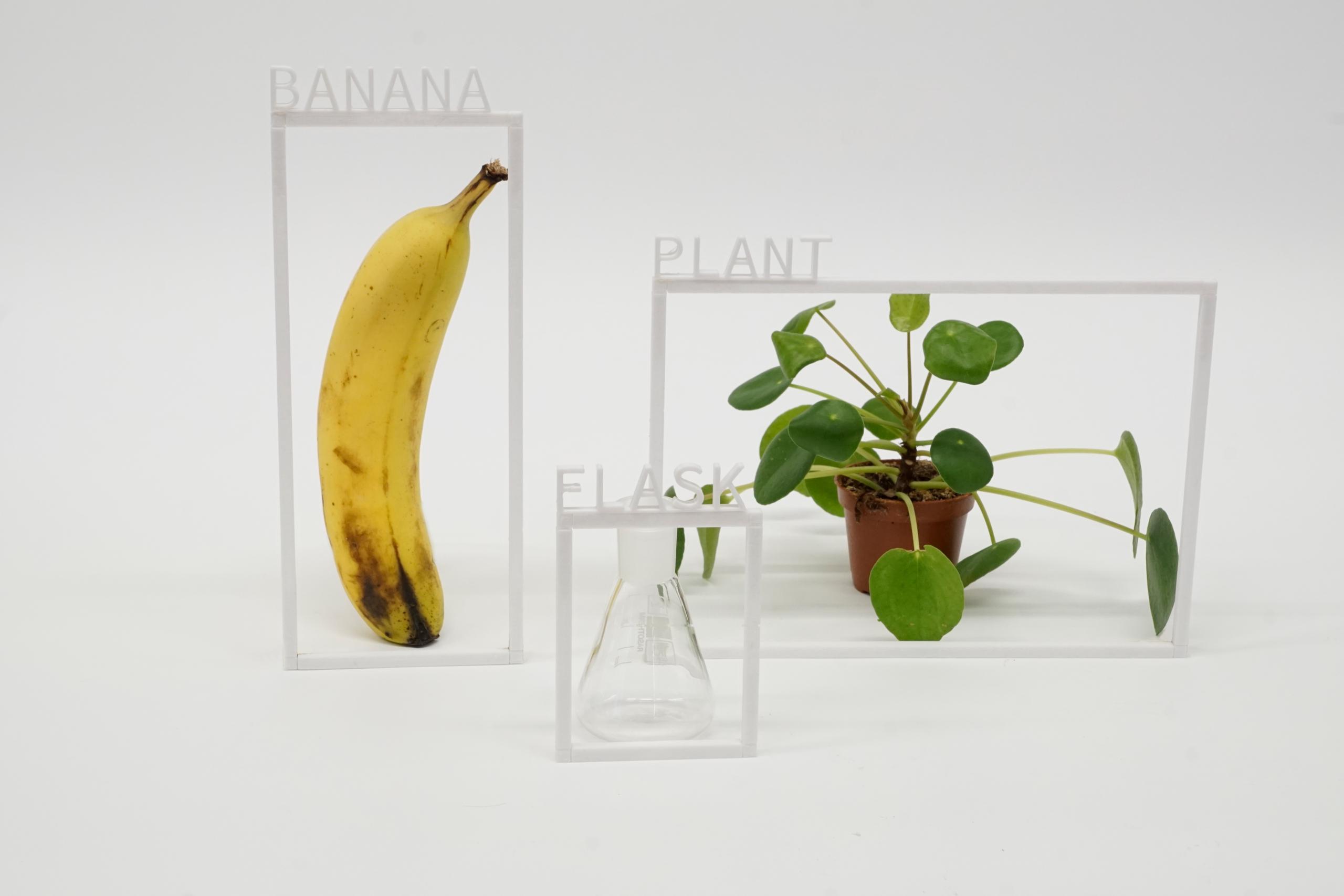
Image: Banana / Plant / Flask by Max Gruber / https://betterimagesofai.org / https://creativecommons.org/licenses/by/4.0/
“Bounding boxes are commonly used in AI research to signify where a computer vision algorithm has detected an object in an image. Here the artist has played with this aesthetic: The bounding boxes are 3D-printed frames positioned in the physical environment around objects. Sometimes the objects stick out of their frame.”
Leave a Reply