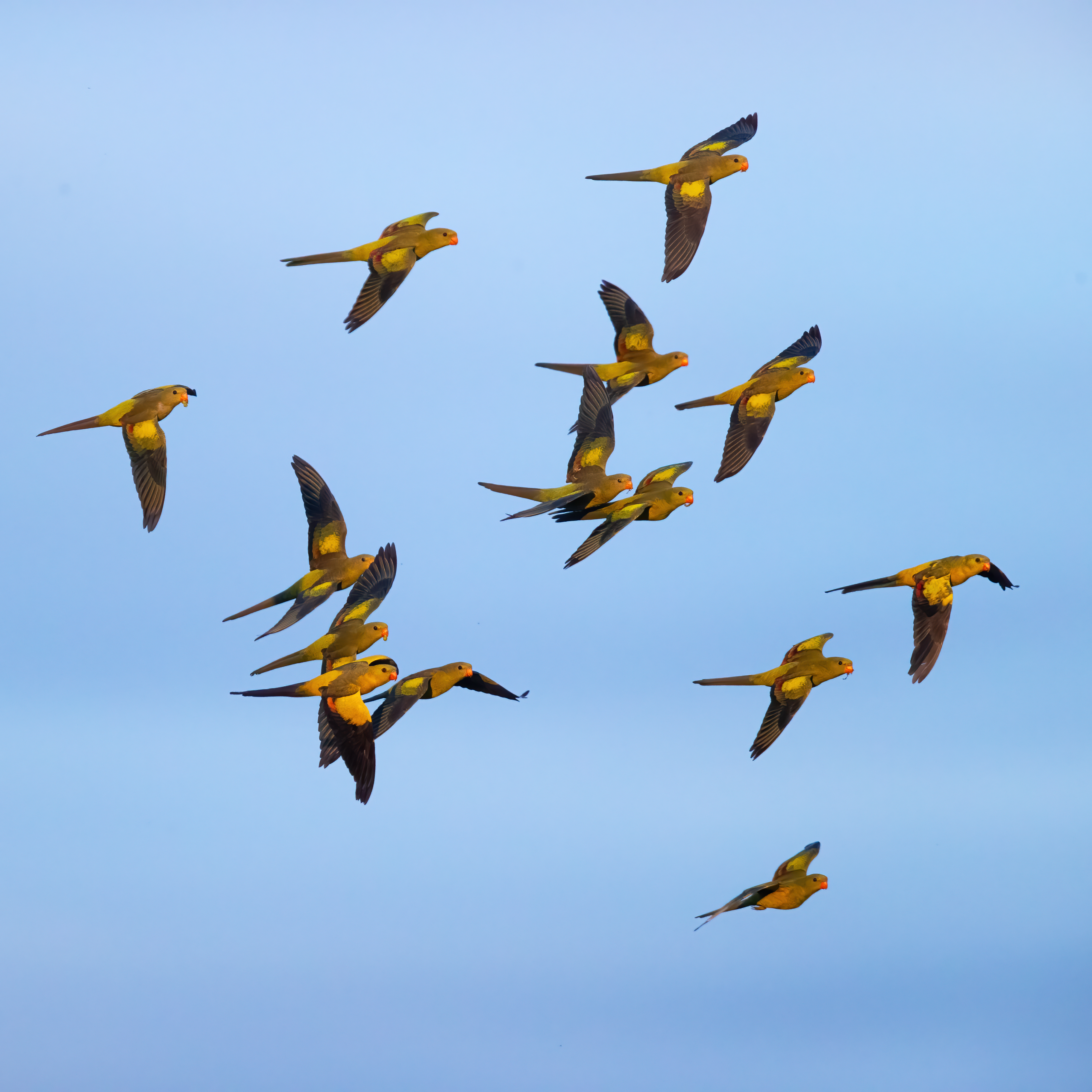
Everyone who has anything to do with chatbots, generative AIs or LLMS knows about the ‘stochastic parrot’, a metaphor created by Emily Bender and colleagues in 2021. It sits on its perch and looks sternly at developers and users of these new computer technologies. At least everybody pretends to know it, because ordinary people don’t really know what ‘stochastic’ means*. However, the phrase as a whole has meaning and provides a feeling of understanding.
‘Stochastic parrot’ is a metaphor used to describe large language models or LLMs that frames these AI systems (and, it should be stressed not all AI systems) as tools that generate plausible-sounding human language (through statistical probability and pattern matching), without having any real understanding of what the words used actually mean (writing this made me smile, as I have done exactly that when learning to speak in a second language).
Now, the parrot was sitting there quietly, when it suddenly looked up and saw not one, not two, not three, but a whole flock of other parrots flying in the sky. Over and above the ‘stochastic parrot’ there was the ‘stochastic flock’, a metaphor created in 2026 by Eryk Salvaggio, a researcher and artist working at the University of Cambridge, UK.
When I first saw that phrase, I was even more baffled than when I first heard about stochastic parrots. So, I had to do quite a bit of searching and reading to extract some meaning from that metaphor – most of it from posts written by Salvaggio.
From parrots to flocks
To be able to understand what ‘stochastic flock’ means, we must move from rather static LLMs that sit there answering our idiotic questions, to AI agents that work together to do all sorts of things for us. We move from chatbots prompted to answer questions to agents prompted to collaborate on solving complex tasks.
As Salvaggio points out, “agentic AI refers to ideal systems that ‘plan’: generating code that writes more code, executing multi-step actions across apps and models, and adapting autonomously”. Salvaggio uses the metaphor of ‘stochastic flock’ to describe swarms or networks of such autonomous AI agents.
From black boxes to black clouds
This moves us from AI and a singular (imputed) ‘intelligence’ to something quite different, a sort of hive mind; and from individual AI ‘behaviour’ to collective AI ‘behaviour’ (two quite different sorts of ‘behaviour’). The metaphor focuses away from seeing AI systems as singular entities and highlights instead that they are a chaotic, interconnected swarm of probabilistic models and AI systems interacting without central control.
And whereas ‘stochastic’ in ‘stochastic parrot’ referred to the calculation of statistical and probabilistic distributions of words, vectors or tokens, it now refers to things more akin to, say, the stochastic modelling of the collective motion of bird flocks, swarms of bees, schools of fish, crowds of people and even murmurations of starlings.
Whereas traditional generative models were for me a ‘black box’ – meaning I didn’t understand how they did what they did – the new agentic world of models has now become something of a black buzzing cloud.
As a technophobe, I can just about use a standalone chatbot, where I give it a prompt, an input, and it provides me with an answer, an output. I have never used agents, where every prompt apparently initiates a swarm or murmuration of interconnected actions, such as searching the web, running code, generating sub-prompts, and auto-correcting errors, as well as, sometimes, deleting your files.
Much like a flock of birds or a swarm of insects, the macro-behaviour of the AI system emerges from the localised, probabilistic decisions of its sub-systems and its micro-behaviour. This makes it notoriously difficult for developers to perfectly predict the outcome. As Eryk Salvaggio quipped on Bluesky: “The flock escapes the aviary when systems interact”.
From one metaphor of critique to another
Both ‘stochastic parrot’ and ‘stochastic flock’ are metaphors of critique and sometimes ‘metaphors of dismissal’ of AI, but the flock metaphor shifts attention away from critiquing the anthropomorphising tendencies that turn chatbots into an ‘intelligences’, and focuses more on the dangers exhibited by swarms of ‘agents’ and the possible inability to constrain and direct a dynamic system. It turns our attention from individual intelligence and behaviour to collective intelligence and behaviour, or rather the lack thereof.
Just as individual birds in a flock have no obvious ‘leader’, so agentic AI systems have no obvious leader or intentional behaviour. However, it should be stressed that starling murmurations have local rules that propagate and shape emerging flocking patterns, and some agentic AI system have orchestration layers. So, we probably need to observe not only the flock but also the orchestrators (and yet another metaphor).
The problem for ordinary users is that stochastic flocks invite blind trust from users. In a way, the trust shifts from trusting a black box to trusting a black cloud. Normal LLMs provided users with smooth and plausible outputs that invite trust. With agentic AI this blind trust sort of multiplies and users might mistake the complexity and fluency of a stochastic flock for genuine listening or understanding.
But, as Salvaggio says: “Errors in an agentic system stack up invisibly until something cracks the façade”. I began to wonder: where would one start to apply (scientific) scepticism here and how would one question such a complex swirling phenomenon? While it is difficult to speak about ‘somebody’ checking facts or truth in a ‘simple’ LLM, in flock-like systems this truth-checking is even more complex and compromised.
From collective behaviour to collective scrutiny
Agentic systems that exhibit unpredictable, emergent behaviour require collective scrutiny even more than individual AIs, as they are based on collective behaviour. We move from patterns of words, vectors or tokens to patterns of flock or crowd ‘behaviour’. As one commenter on Bluesky astutely asked: “A flock is interesting because it admits emergence, the murmuration does what no single bird intends. But that concedes what the parrot denied, the whole does what the parts cannot. So once you say flock, have you not let collective behavior back in? What does the flock know that no parrot could?”
Computer scientists and AI experts are working hard to get to the bottom of such questions and to monitor, audit, steer, constrain and limit what a stochastic flock does, but writing about that, or even pretending to do so, is beyond my limits of understanding! For the moment it’s enough for me to have noted this emergence of a new metaphor that builds on an old one and to have added it to the #AIMetaphorObservatory.
PS In a future post I might try (or not!) to grapple with what I call the ‘language of the flock’ or the emergent collective language of AI agents working together, an issue just highlighted by Ethan Mollick….
Footnote *: ‘Stochastic’ is a mathematical word that simply means based on probability. Instead of following a fixed, predictable rule, a stochastic process has multiple possible outcomes that are governed by probabilities. Think about playing a game of Ludo rather than chess and where every move is determined by a throw of dice.
Image: Wikimedia Commons: Elegant parrots in flight, Patchewollock, Victoria, Australia by JJ Harrison


Leave a Reply